Showing posts with label oklahoma. Show all posts

Wednesday, June 1, 2011

Oklahoma -- Part 3 -- Corn, Custer, Cheyenne

For most of my life, when people asked me where I was from, I said without a doubt that I was a Minnesotan. I'd lived in the state from ages 10 to 24, and came into my own in the woods, lakes, and depths of lush nature in that place. I've always believed that without Minnesota, I'd have lived a much more insular life--one devoid of the awareness of cultural, spiritual, and physical diversity in this world (not that I'm exactly still that aware). I am a Minnesotan.

I worked hard to deny the first 10 years of my life in Oklahoma. Whenever my grandma in Oklahoma called on the phone--often just as our favorite family tv shows were beginning or in the middle of dinner--I groaned. When we had to visit the state Mom would, it seemed, hold her breath the entire time. My Dad grew up there, and I've always wondered how he felt about the denial of my real roots. I didn't learn about the state bird or state anything of Minnesota; I grew up coloring in pictures of scissortail flycatchers and singing "Oklahoma" from the musical of the same name in elementary music class.

I never wanted to hear the stories of my German Mennonite progenitors. When my Grandma or any other old person kissed me on the cheek and proclaimed, sometimes in unintelligible Low German, some special story--even if about that fantastic zwiebach bread--I shirked in boredom. This is all partly being a kid, I know, but it has defined the depression, darkness, and emptiness I associate with Oklahoma. As I've turned to face my childhood, I crave the stories that are gone. And as I've heard only a few from the last of my grandma's siblings, three sisters, something has begun to shift. I will never live in Oklahoma again, but as an adult I crave the stories like.... well, the only thing I can equate it to is the time I had acid reflux, no one knew that's what it was, and I was on a diet of mashed potatos and lime gatorade. I hated that gatorade, it was nasty and fowl. Now? There are days nothing else will do and I drink an entire liter in one gulp. Such is Oklahoma now for me. Such may be the next book.

Gyp Creek, where my great grandfather fished
just south of the homestead.


After visiting the Wichita Mountains, my wife and I headed north to Corn--where my great great grandparents homesteaded in 1894--and a bit further to Weatherford, where I grew up. I still, even writing this now, find it hard to realize that much of who I am and how I perceive the world is defined by that early Oklahoma perspective: conservative, guarded, obstinate, determined, seasoned by the soil and sun. Yet there's something I can't put my finger on now, not yet. Something in the history of this state defines me like an afterimage, a ghost, a memory I never lived but is encoded in my genes. Sometimes my wife still catches traces of my once-heavy southern drawl, a "rut beer" instead of "root beer," or a "y'all" with too much twang.

Oklahoma was lawless in the 1800s. Squatters (sooners) staked claim wherever they wanted, including in Indian reservations, then complained to the government that they received no protection from the Indians, or had any political say with the Indians. Bands of cowboys, for a decade, clashed with Indians and farmers as they drove cattle north to Kansas to be shipped east and west. Gangs ravaged settlements, law was enforced from a distance in Missouri or Arkansas. More and more Indian nations were being crammed into the territory as reservations divided and shrank. The Civil War destroyed any wealth Indians had accumulated in their new lands prior to the 1860s.

I had no idea that, just over an hour west of Weatherford, was the site of a battle in which Custer slaughtered a Cheyenne village along the Washita River, just 20 minutes east of the Texas border. In 1868, a time when the military made political policy in the Plains (even if the federal government had made other policies), there seemed to be zero tolerance toward "Indian agression."

This agression was one of tradition, in part--young Cheyenne men trying to prove themselves as warriors as they've always done, raiding others as a sign of prowess, raiding wagon trains and cabins on the frontier. Dog Soldiers, a warrior arm of the Cheyenne, faught back the white invasion like a gorilla force. Near Cheyenne, along the Washita, peace chief Black Kettle, as an advocate of treaties, had so lost the respect of these men and other Cheyenne that he was forced to camp his band further west, away from the main winter encampments. Under pressure to subdue the Indians at any cost, Sheridan, in Kansas, ordered Custer to march south into Oklahoma Territory and strike the Cheyenne when they were their weakest. In winter.


On November 27, 1868, Custer attacked from four directions at dawn. In order to creap up to the village undetected, the soldiers dropped most of their clanging gear, any shiney objects that might reflect in the moonlight, and Custer killed his barking dog. Dozens of Cheyenne were murdered at sunrise. Women grabbed children, ran to the Washita River, and tried to dig foxholes in the sloped banks as they were fired upon.

A contingent of about 20 U.S. soldiers to the east were the least fortunate, having been cut off and surrounded, then all killed. It was a premonition of the Little Bighorn years later, when Custer would use the same exact military strategy against the nothern Cheyenne, but to a much different outcome.


As my wife and I walked the battlefield, overlooking the vista from nearly the same point where Custer directed and observed the fighting, I felt like I shouldn't be there. I asked a park ranger--the site is run by the National Park Service--how the Cheyenne felt about this all, specifically Cheyenne peace chief Lawrence Hart (also a mennonite pastor), who I knew lived in nearby Clinton and advocated for this site to congress. "They are all for it," the young ranger said. And I believed him. And I didn't.


I made sure not to take too many photos, and certainly none of the many prayer cloths hung in trees. As we followed the mowed trail through a restored prairie on what was the main battlefield and is now the Black Kettle National Grassland, we passed a portion of the creek where Black Kettle and his wife were shot off their horse. A wirey white couple and young boy were picnicing / fishing near the shallow water.


Black Kettle's band had, only four years before, also been massacred in Colorado at Sand Creek. That his village was the one attacked again was coincidence, for Custer happened upon it first. After the battle Custer ordered all 800 Cheyenne horses shot, robbing the Cheyenne of the ability to fend for themselves, and eventually forcing them to nearby forts and more subjugation. Custer also took about 30 women prisoners, and there's strong indication that he and his officers raped the women on the way back to Kansas, even as Custer's wife awaited his return.

It is unfair to to say this is what Oklahoma is, that examples like this color the state. But it is hard to deny the images and echoes of Native America on license plates, billboards, strip malls, and sculptures like the one atop the state capitol. In one sense, these images are an act of the "guilty" trying to make up for atrocities--they are token acts of healing that, to me, seem to only fuel the fire of misunderstanding and cultural appropriation, to Indian-ize the Indian.

What's left of the homestead, and some short winter wheat.


My family homesteaded on virgin prairie, an allotment purchased after the Dawes Act dictated that Indians must choose their own allotments first (160 acres), as the reservations were being eliminated and those lands opened up to white settlers. My family fled the Netherlands in the 1500s amid stake burning and lynching for being heretics, then from Prussia (Poland) in the 1700s, then from Russia to escape military conscription. They were farmers whose Christian beliefs were, in retrospect, only subtly different than other Christians. They were also, in their way, an extension of an avid Mennonite boarding school program that shipped Indian children east.

The barn, half gone in just two years.


"Each windmill makes
its own distinct song."


My family took a train from Russia to Germany, with only a few cedar chests and bags, then a steamship from Germany to New York City, then another train from New York to Kansas in 1874 (likely stopping in Lincoln, Nebraska, where I now live). Twenty years later they got on wagons and headed for cheap, open land again, this time in Oklahoma. And as before, many times, they made something from nothing, fulfilled the duplicitous wishes of a government who had political and economic motivation behind them to populate Oklahoma, just as Russia had after conquering the land of the Russian Steppes. To belittle settlers is wrong. But to wholly wash them clean of a multifaceted history also seems wrong, just as it is for ourselves today on issues of race, gender, politics, religion, healthcare, fossil fuels....

Weatherford wind farm


Drilling near Cheyenne


Perhaps for me Oklahoma is truly what some cultural historians have called it--an excellerated microcosm of western expansion, of all that is good and bad with American existence itself. In only a few decades an "empty" swath of land was not just colonized, but completely and totally reformed into an unecognizable physical landscape, to say nothing of the cultural upheaval that occured across its soil. The speed of this "reformation," almost blind and deaf in its train-like / tornado-like rolling across the prairie, is simply unimaginable.

Funeral home advert rain gage
in barn--notice the pre 1920s
phone number of 140.


So, maybe, Oklahoma is my facing facts, is my looking long into the mirror. I have always felt uneasy there. It is still, in essence, wild, even amidst the pumpjacks, fences, windfarms, and fields of wheat and cotton. As the wind tears through the open windows and doors of grey farm houses, as it lifts soil from between crops, as it sculpts and contorts the few oaks and cottonwoods along shallow creek beds into half rainbows of bark, it is not hard to hear the echoes of those that have come before, of the people: Cheyenne (who called themselves "the people"), Arapaho, Kiowa, Wichita, Caddo, the bison, black bears, elk, and prairie dogs, the bluestem, switchgrass, coneflowers, and leadplant, my grandmother, great grandfather, great great grandparents--and finally myself, a boy with red dirt in the corner of his eye, unable to get it out, stinging until I ignore or accept it and absorb it into myself.

Part 2 -- Wichita Mountains, Fort Sill, Geronimo
Part 1 -- Tallgrass Prairie Preserve, Bartlesville, Oklahoma City, OKC Memorial

Sunday, May 29, 2011

Oklahoma -- Part 2 -- Wichita Mtns

As a boy growing up an hour north of the Wichita Mountains, and later during visits, I remember that on a clear day you could see the mountains off in the distance. To be fair, they may be more like large hills, though the two highest peaks reach over 2,400 feet. This portion of our 8 day voyage was probably the highlight (or tied for it)--I've never felt so at home in Oklahoma as I did here. The place was incredible, and we saw only a small fraction of it, made evident by the fact we only saw longhorns and bison, no elk. I'd go back in a heartbeat. I can't believe I just said that. It did not feel like Oklahoma at all, even with the red dirt.

Near Lawton in southwest Oklahoma is the unplowed and untouched WM Wildlife Refuge (60,000 acres), as well as Fort Sill--the latter being the largest artillery training school in the country, and comprising a large chunk of the mountains as a firing range (alas). More on the fort later.

One range of many set against the undisturbed prairie


Within the refuge are many lakes, I mean dammed creeks. Below is Lost Lake, where for a brief time I did indeed feel its name.

The diverse vistas--water, prairie, woods, rocks


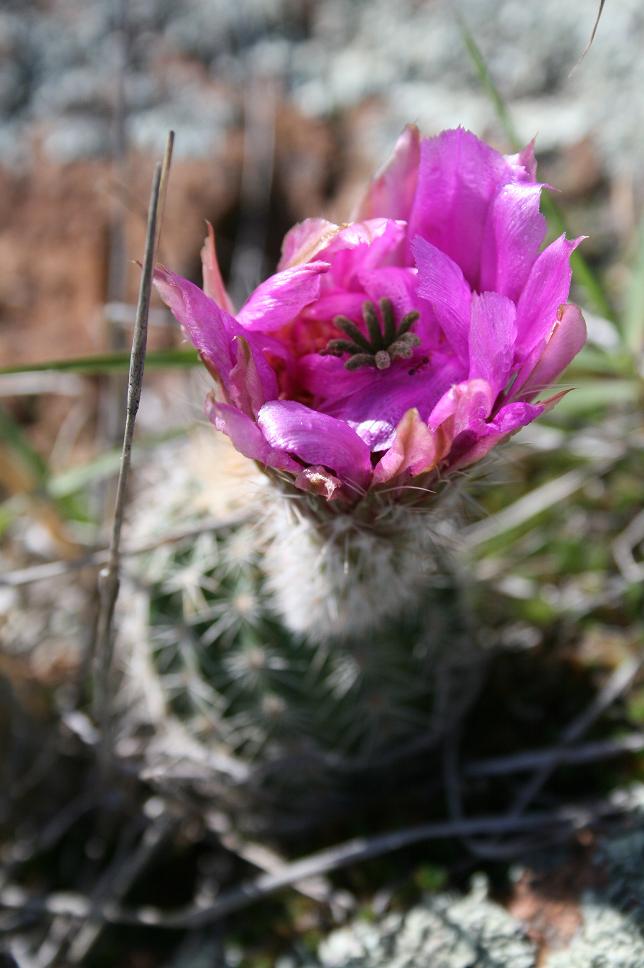
Cactus bloom


Central Oklahoma used to be awash in a north / south strip of post oaks and blackjack oaks called cross timbers, which are short, thick-trunked, wind-stripped trees that were virtually impassable for wagons. Below is a small remnant in the WMWR.


We also took the winding road up Mt. Scott, the second highest peak in the range. I was absolutely terrified driving the car, thinking that at any moment I'd suddenly go insane and rev the car off the road and make us plummet to our deaths (I hate 6' ladders, mind you). My wife scoffed. But once our ears popped and we made it to the top, she was scared to climb the rocks and peer down, whereas I felt like a little boy, giddy as I hopped large boulders in a single bound. I'm a prairie boy, so it was a whole new plain of existence (get it? huh?).


The Wichitas are over 500 million years old, the oldest mountain range in the U.S. In the late 1800s gold was reported, and many soldiers deserted from nearby Fort Sill to strike it rich, but no gold was ever found.

That's a road way down there
Wind farm in the distance


We met a drawly man at the top with a troop of teenaged boys, and he pointed out what must have been tens of thousands of lady bugs. They were on trees, rocks, leaves.... Why were they there? He gathered some to take home to his garden (he also later told us how he recently went on a junk-hunting excursion when a local lake was drained, and about all the neat bottles he found).

One of the few black-tailed prairie dog colonies is also in the refuge. There's one in Lawton, too, after the townsfolk gave up eradicating them from their parks. It seems to me the plow did a good enough job of that in the Plains.

Mom watching the kids?

Would love to know what ground cover they were eating.


I want these flowers carpeting my lawn.


I had to literally pull my wife away from the prairie dogs. I see giant rats, she sees cute furry squirrel things to play with and kiss. But it was neat how, driving through the refuge, you suddenly roll right through their town. They scamper across the road, walk right up to you, call to one another from hole to hole, dart in and out of holes, peek their heads out like womp-a-moles at the arcade....

The last bison?


The refuge has a small bison herd, started from a NYC zoo contingent, as wells as re-introduced elk, deer, and longhorn cattle that look more menacing than the bison even while they're lounging.


Then there's dung beetles hard at work rolling stuff around backwards:


And after days of my wife pointing out darting scissortail flycatchers to me, I finally got a picture:


Northwest of the range is Rainy Mountain, a Kiowa sacred site that author N. Scott Momaday writes so eloquently about in his book The Way to Rainy Mountain. You might have noticed me quoting him in three previous posts the last two weeks as an invocation--a sort of watching over of the trip.


"Loneliness is an aspect of the land. All things in the plain are isolate; there is no confusion of objects in the eye, but one hill or one tree or one man. To look upon that landscape in the early morning, with the sun at your back, is to lose the sense of proportion. Your imagination comes to life, and this, you think, is where Creation began." -- Momaday

North of Lawton, and extending all along the southern edge of the mountains, is Fort Sill, established in 1869 shortly after the massacre of Black Kettle's Cheyenne band up the Washita River (that's the next blog post). It is the only remaining fort from the southern Indian Wars and the Red River War still in use today--and in lots of use. We drove by about 100 cadets training in full gear near a patch of woods. Machine guns. Camo. Trucks. It was strange how at the main gate the guards simply scanned our driver's licenses, then waved us through, along with hundreds of other cars. The guard who greeted us had a hook for one hand.

Ft. Sill is the resting place of Geronimo and several of his wives and children. Why do we yell "Geronimo" when we make physical leaps of faith? Because we're culturally ignorant. No, (yes) it's actually after a presumed leap Geronimo made off the nearby Medicine Bluffs on horseback while trying to escape, but no such thing ever happened. Paratroopers stationed at the fort used his name while jumping from planes.


Quanah Parker is also buried at Ft. Sill. However, unlike Geronimo, his grave is at the center of the fort, not several miles west across I-44. Parker was the last of the Comanche chiefs to surrender--his mother was a captured white woman who was adopted into the tribe. Parker went on hunting trips with Theodore Roosevelt, and was one of the founders of the Native American Church, a blending of the peyote religion and Christianity.


And it is fitting, with all this Native American history buried at the fort--and the similar (ab)use of the rare ecosystems of the Wichitas--that our last image be of this:


My grandfather would have driven something similar--a mobile howitzer--in the Korean War. There were many impressive track and field artillery pieces dating back to WWI on the grounds, and of course, original buildings from the 1800s, including the guardhouse where Geronimo was held.

Oh, I can't end there. Here's something my wife pointed out:


I wonder how he managed during that night's baseball-sized hail? We were fortunate to JUST BARELY avoid hail and tornados the entire trip. When we left Oklahoma to return home, the interstate we drove that morning near El Reno had a tornado cross right over it in the afternoon, killing several people nearby.

Next and last stop, my family's 1894 homestead, and the Washita Battlefield where Custer began the myth behind the man. And, perhaps, where Oklahoma truly ends and begins.

(For part 1 of our trip to Bartlesville, the Tall Grass Prairie Preserve, and Oklahoma City, link here.)

Friday, May 27, 2011

Oklahoma Trip -- Part 1

This is the first of two posts, maybe three, on an 8 day trip my wife and I just took to Oklahoma. My next memoir will be based on the state--where I was born and spent 10 years of my life, where my great great grandparents homesteaded, where so much of what America is can be seen in a supercharged microcosm of greed, ignorance, violence, hope, faith, and denial. Somehow, I have to navigate the collision of Native Americans, immigration, homesteading, farming, prairie, oil, and religion--and my own feelings about a place full of darkness for me. Hence my second trip in two years to face this emotional thing. I never knew Oklahoma, certainly never wanted to, but now I've turned to face that thing which has been stalking me all my life--indeed, my family since 1874. I had to finally begin to SEE Oklahoma, at least physically.

Bartlesville--OKC--Lawton--Corn / Weatherford--Cheyenne


So to begin, we'll go chronologically. My wife and I started in Bartlesville, in the northeast corner (the trip map is above, our path highlighted in green). Along with Tulsa, Bartlesville is an oil mecca of Oklahoma, where towns of tens of thousands sprung up literally overnight. Of course, the same can be said for towns that resulted in land runs. Northeast Oklahoma is hilly and full of trees, and by the time you make it west, the soil has become red, there are few trees, and lots of cactus and yucca.

How "loose" are the bison?


Our purpose in this city was to talk with one of my grandma's sisters about her childhood, and also to see the Tallgrass Prairie Preserve, managed by the Nature Conservancy. The 30,000 + acres were never plowed, just grazed, and the Conservancy has been working for around 20 years to restore the flora and fauna. Part of that restoration includes a herd of 600 bison.

These guys crossed the road in front of us,
then scratched themselves on the info sign.

Small herd on a hill


While we were a bit early to see wildflowers--and certainly early to see the tallgrass of late summer--it was nevertheless inspiring to see this remnant prairie, one which tangentially extends far north into eastern Kansas in the Flint Hills. As an aside, the backroads of southeast Kansas were far more beautiful then I'd imagined.


Bartlesville also has the last surviving steam engine from the AT&SF line, 1 of 332. The 940 was built in 1903 in Philadelphia, and was in service for 51 years. It is 80 feet long and weighs 150 tons loaded with water and coal / wood. It's top speed was 35mph. Restored just a few years ago, it's a marvel to me, and an iconic image of westward expansion, the dicing up of Native American lands--something both monstrous and beautiful in its design.


Also a marvel, were the many painted bison in town--clearly a community arts project. My wife pointed out this bull to me with disco ball "maleness."

Nota bene--don't try this with a real bull.


There was a man on a nearby bench watching us.


Bartlesville is home to the only "skyscraper" designed by Frank Lloyd Wright, the 19 story Price Tower, built in 1956 for an oil pipeline mogul. The building is clad with copper.


After Bartlesville we drove 90 minutes to Oklahoma City, where I wanted to visit both the OK Historical Society and the Oklahoma City National Memorial.

The memorial was, if this doesn't sound crass, the most beautiful, subtly moving, and elegantly designed memorial I've ever seen. It was evocative in its minimalism, creating silence and peace and reflection in ways even more powerful than the Vietnam Memorial in D.C. The Murrah Federal Building was bombed on April 19, 1995. Each chair is inscribed with one name of the 168 men, women, and children who died. Every row represents the floors where each victim either worked or was visiting. The south end of the grounds still has some of the original foundation walls, where rusting rebar protrudes from the poured concrete.


"We come here to remember those who were killed, those who survived and those changed forever. May all who leave here know the impact of violence. May this memorial offer comfort, strength, peace, hope, and serenity."


We then visited the Oklahoma Historical Society, along with at least 100 junior high kids (loud, and constantly texting as they viewed exhibits). It's a nice building overlooking the state capitol--the capitol is the only one in the nation that has a working pumpjack on its grounds pulling up black gold.

We also talked with an older gentleman, a volunteer docent, who was once a professor whose field I can't remember. But his son is working on trying to make ethanol from switchgrass (die corn, die!), and I couldn't help feeling that here in Oklahoma, at the heart of collective history, across the street from big oil, another world was beginning to violently collide with an old one, just like it did during the land runs only a little more than 100 years ago. But that's a story for the next post, one of nature, the Cheyenne, and Custer; it's a more personal story, too.