You've got 3 days left to either win a copy of my poetry collection, or buy it (or both?). September 3 is the last day to purchase presale copies which come with cheap $1 shipping.
Here's info on how to win a free copy of the book.
And here's where to buy it.
Without Such Absence will be released on 10/29 and will thereafter be available on Amazon et cetera.
Tuesday, August 31, 2010
Thursday, August 26, 2010
On Wonder
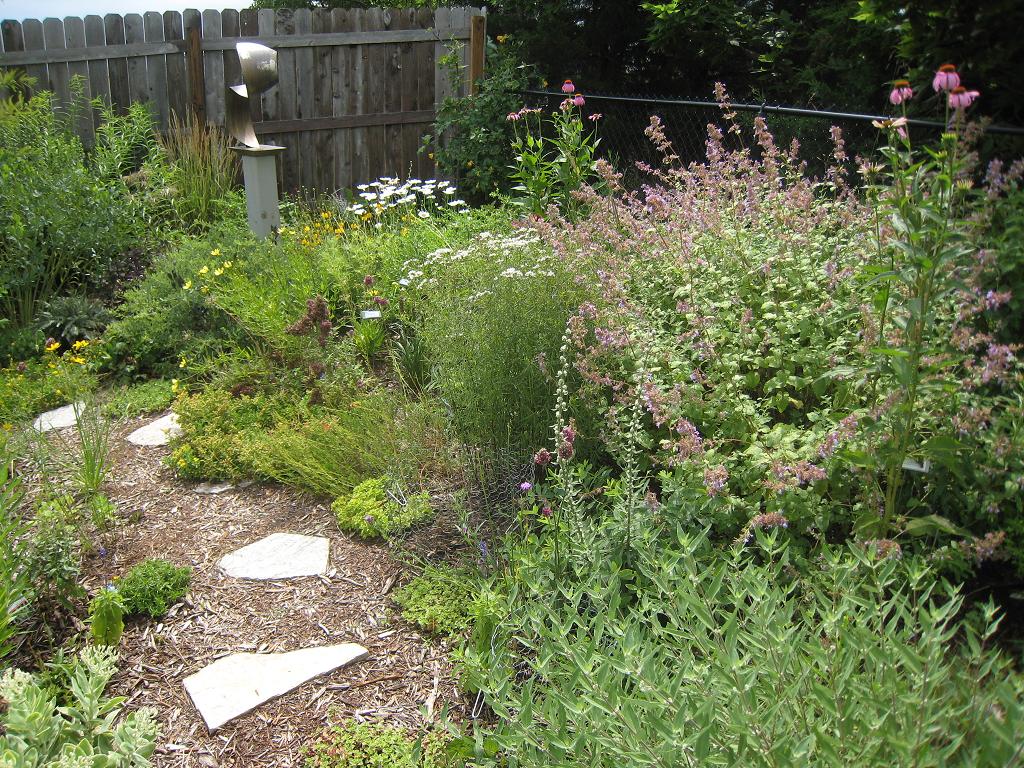
This is the first year I've become lost in the garden, and to some degree I mean physically lost. The smokebushes are 10' tall, the eupatoriums and ironweeds and sunflowers are thick masses, the grasses broad and unfurling their plumes of seed-like earrings / many small chrysalides.
A large female garden spider has made a web near the base of a clump river birch, tied fast to verbena and mountain mint. Sometimes I help her out. Fair warning. There are plenty of grasshoppers, and if I'm quick enough I can capture one in the curled palm of my hand. I'll rush over to the web, the grasshopper pinching and scraping at my skin, and toss it to the spider. She sometimes gets to them, but more often than not the grasshoppers work their way out and fall to the ground. But it's fascinating to see her spin a thick Saran Wrap-like film over her prey. Or, our prey. The grasshoppers feast in my garden.
When I got home from teaching yesterday, my wife and I released 7 monarchs (5 more today). One made a mad dash for the sky, the rest flitted and settled on the bald cypress, morning glories, or butterfly bushes. Nearby a preying mantis waited. The skippers and soldier beetles, numbering in the hundreds if not thousands, patrol every last bloom, often resting in my hair or on my shirt. Bumblebees wedge into shriveled up morning glories and thin-lipped turtlehead blooms. Recently, a hummingbird has begun stopping by an hour or two before dusk to nectar at every last 'Nekan' blue sage bloom.
Ants are harvesting the aphids. Tent caterpillars have invaded the baptisia (it looks like Halloween). A highlighter-yellow goldfinch picks dried coneflower seeds from a blackened stalk.
Only 1,500 square feet and I think about how much I'm still missing, but know how much I've ceased to miss. Such a small place can become one that is infinite--the purest essence of wonder.
The side of our house gets a half day of light, morning sun. It is a dark, damp place come mid afternoon, with dogwood, ninebark, 'Fineline' buckthorn, spiraea, willow, and crabapple. It is both a simple place in its lack of flowers, and a subtle yet complicated place structurally. For this reason I feel the most secluded and calm here, as do the many tree fogs. Last night I watched as one climbed the gold-leaved smokebush near the top, stopped on a leaf, and seemed to gulp the air. The night before 5 of them were spread on the south wall around the back door, catching insects attracted to the interior light seeping through curtain edges.
| Argiope aurantia |
A large female garden spider has made a web near the base of a clump river birch, tied fast to verbena and mountain mint. Sometimes I help her out. Fair warning. There are plenty of grasshoppers, and if I'm quick enough I can capture one in the curled palm of my hand. I'll rush over to the web, the grasshopper pinching and scraping at my skin, and toss it to the spider. She sometimes gets to them, but more often than not the grasshoppers work their way out and fall to the ground. But it's fascinating to see her spin a thick Saran Wrap-like film over her prey. Or, our prey. The grasshoppers feast in my garden.
| Monarch on Coreopsis tripteris (tall tickseed) |
When I got home from teaching yesterday, my wife and I released 7 monarchs (5 more today). One made a mad dash for the sky, the rest flitted and settled on the bald cypress, morning glories, or butterfly bushes. Nearby a preying mantis waited. The skippers and soldier beetles, numbering in the hundreds if not thousands, patrol every last bloom, often resting in my hair or on my shirt. Bumblebees wedge into shriveled up morning glories and thin-lipped turtlehead blooms. Recently, a hummingbird has begun stopping by an hour or two before dusk to nectar at every last 'Nekan' blue sage bloom.
| Bumble bee on Chelone 'Hot Lips' |
Ants are harvesting the aphids. Tent caterpillars have invaded the baptisia (it looks like Halloween). A highlighter-yellow goldfinch picks dried coneflower seeds from a blackened stalk.
| Soldier beetle pulling itself up to Eupatorium 'Wayside' bloom |
Only 1,500 square feet and I think about how much I'm still missing, but know how much I've ceased to miss. Such a small place can become one that is infinite--the purest essence of wonder.
Sunday, August 22, 2010
The Lion's Tooth
Here's my short essay on plant rights, praising the weedy dandelion, the origin of flowers, and mass extinctions. I put this up in January 2009 (when it didn't fit in my memoir--it still doesn't), and am doing so again because it will be appearing in ISLE: Interdisciplinary Studies in Literature and Environment this fall (and is in fact already online, link at end of the post).
-----------------------
At the front corner of our yard when I was growing up, where a sliver of lawn separated our driveway from the neighbors', the mailbox stood covered in the full glory of a finicky, magenta-blooming clematis my mom finally got established. From a block away this mature vine was a beacon—the subtle and regal color, the thick petals, and the puffy stamens. Someone who knew how to garden lived here. But in the grass popped up the misplaced bright head of a dandelion bent on ruining the majesty of the queen of vines. You could see it from inside the house, fifty feet away, like a pulsing strobe light. You could see it from down the street. At night you could, invariably—according to my mother—see it from an overhead Northwest Boeing 727 making its final approach to Minneapolis-St. Paul International. It was like an overnight pimple on the rejuvenated skin of my mom's late-spring landscape.
Dandelions provide one of the first sources of nectar for bees and other pollinating insects in spring, and confirm the first glimmer of hope we had when, back in March, the temperature briefly hit sixty. With their proliferate seed heads, dandelions are a staple of the American landscape. Once, when English colonists came to the new world, they were also an imported food staple, a cultivated delicacy for garden salads. Still, as humans have spread over the last 100,000 years, reaching North America some 12,500 years ago, the development of agriculture has placed us above and out of the confines of our environments—leading to the inevitable disappearance of over 95% of the plants the pilgrims saw in the new world. According to biologist E.O. Wilson, the earth loses nearly 3,000 plant, animal, and insect species each year, or three every hour. This constitutes what many scientists call the sixth great mass extinction in the 3.5 billion year history of the earth.
As the continents drifted apart long ago, separate and distinct ecosystems began to emerge. One such place can be found in the Hengduan Mountains of southwest China, the most biodiverse temperate forest in the world. Over the course of one day, starting from the valleys to the high ridges, one can move through all four seasons as the climate changes. This strong box of genetic diversity was perfectly placed to survive the ice age's glaciers that ravaged the fauna and flora of North America and Europe. As a result, many of the world's most common ornamental garden plants originate here.
Toward the beginning of the cretaceous period, dinosaurs were flourishing amid tropical and moist landscapes. On the basis of the pollen spores found in ancient sediment the world over, the first flowers began to appear among these reptiles some 134 million years ago. A recent fossilized discovery by paleobotanists Sun Ge from China and David Dilcher from the United States, shows a flowering plant named archaefructus dating to around 125 million years ago in northern China. Though it lacks petals, and while alive had no scent, it is not primitive enough to be the definitive first flower—but it is the first visual record of such a plant in the world.
The end of the cretaceous period, 64 million years ago, marked the most famous extinction period the world has ever seen, that of the dinosaurs and an estimated 50% of the total species on earth. The largest extinction occurred 235 million years ago when over 90% of the species vanished. Niles Eldridge, paleontologist and a curator of the American Museum of Natural History, says scientists have discovered a recurring pattern in these extinction events that cycle at about every 64 million years; and though they are usually caused by forces such as tectonic shifts, volcanic eruptions and meteor impacts, the current period is clearly caused by creatures living on the earth.
As human agriculture, through the monoculture of its crops, brings an end to ecosystems that support vast species, as fences and poisons and suburbs create barriers to migration routes, as foreign invasive species are brought in accidentally or to beautify our foundation plantings, in our eyes, native species become pests and die away. Through farming, humans no longer fit into the larger picture, are no longer bound or balanced by a place's ability to physically sustain them. But eventually, at around 10–13 billion people, our agricultural effects may catch up with us and we will outgrow the planet's capacity to nourish us, even with the advent of genetic engineering of crops and animals. With projections of human population to be at 8 billion by 2020, we simply dwarf the estimated 10–30 million species of other life forms that we rely on to replenish and maintain our world. If we truly are in the midst of the sixth extinction, Eldridge says that the hope of our population cap will mean the level of lost species should not reach that of the largest extinction 235 million years ago.
Such statistics aren't meant to terrify, or even to humble in the strictest sense, but they should make one more aware of the value—beyond nature for nature's sake—of the biologic and human cultural diversity that needs to be preserved in order to balance ourselves with the world for the first time in our species' history.
When I was growing up my dad had a gas edger. He fitted a makeshift metal tube to the exhaust of this edger and shoved it down into holes we found in the yard. For my mom, if she could, she'd use as violent a means to rid the world of dandelions—with a passion for Armageddon that I've only come to know recently, all dandelions must die. Their seed must be wiped from the earth. One spring I casually mention over the phone how happy I am to see dandelions, that their emergence means the forsythia and tulips are not far behind. "I hate those damn dandelions," she replies. "I wish I could pluck every last one of them so we'd be done with it." It seems strange to me as I think about dandelions as a foreign species, brought here by us, thriving in spite of our chemicals. Don't they now have a right to exist, much as the fictional Frankenstein did?
In Switzerland, the government has requested that an ethics panel weigh the dignity of plants, or, to find out what plants' rights actually are. Is pulling a dandelion morally wrong? According to journalist Katherine Kersten, "The Swiss have added a provision to their constitution requiring ‘account to be taken of the dignity of creation when handling animals, plants, and other organisms.’" The ethics panel was formed in an attempt to give such concerns practical examples and applications. One illustration is the following, where Kersten is citing Wesley Smith from the Weekly Standard:
A farmer mows his field [apparently an acceptable action, perhaps because the hay is intended to feed the farmers' herd—the report doesn't say]. But then, while walking home, he casually ‘decapitates’ some wildflowers with his scythe. The panel decries this act as immoral, though its members can't agree why. The report states, opaquely: ‘At this point it remains unclear whether this action is condemned because it expresses a particular moral stance of the farmer toward other organisms or because something bad is being done to the flowers themselves.’
This panel does not consider that genetic engineering is unacceptable to the plant's dignity, but it would be so if it caused plants to lose their independence as free, reproducing, and wild organisms. I wonder how many "introduced" cultivars of plants in the gardening industry have lost their own dignity over the centuries? But still, is my mom insulting the flora, feverishly yanking every dandelion flower and sharp-leaved stalk from the ground? The entire wildness? The creation itself? Or is she saving the native plants? If we genetically engineered a dandelion that acted more like a prim and proper front-of-the-perennial-border ground cover, what would change? Our dignity might increase at the expense of the plant's—perhaps.
Walking along the back fence of my small lot, I noticed my neighbor—who lives on a mostly wild three acres—came along his back property line and yanked out large prairie thistles. Then, apparently, he laid them down parallel to my fence, almost as if they were sacrificial offerings. I don't know if he thought I'd planted them, or what statement he might have been making. I do often seed just over the fence line—perhaps he saw me—simply because I'm amazed his wild backyard only grows invasive cedars, not one wildflower benefitting bird or bee anywhere. We need prairie thistles.
And we need dandelions. I need dandelions. They're the first bright sign in spring that winter is finally over, yes, praise be, finally over. And I've come to appreciate them for this reason mainly, but also for their importance to, say, emerging queen bumblebees hungry to start a new colony. I also have fond memories of frying their blossoms at camp one year, and drinking warm Kool-Aid to wash them down. In a way, this flower is my first flower—likely the first one I ever touched as a child, the petals staining my knees as I roughhoused outside or whose seeds I blew in to the air.
The dandelion is a weed because it doesn't belong here. The dandelion is a weed because it has the ability to spread quickly and thickly on disturbed land, and its progeny will always lay waiting just beneath the soil, hidden under other plants, caught between blades of grass or cracks in concrete where the rain settles it in so we can't get to it. The dandelion is a weed because it reminds us too much of ourselves, of how our own thoughts and actions can suddenly become loosed from our ethics and morals. It seems such a plant should be placed at the center of our gardens.
reprinted from ISLE, link here
Monday, August 16, 2010
Raising Butterflies
This post will confront my insanity, and provide some insight into raising monarchs and swallowtails. I hope. Did you all get my thesis statement? I hate thesis statements, and refuse to let my students use them, by the way.
So a few weeks ago I bought a used 10g aquarium and did this to it:
See his shriveled skin and antennae? The line on his side? (or her) I love seeing that skin slide up and off:
This monarch (below) attached to the side, and has a flat dent. Rumor has it things will work out. We will see:
Tachnid flies lay eggs in monarch larvae with a vengeance, and often the monarch "J"s up early, dies, and hangs limp as the tachnid fly larvae slides out on a slime thread. Swallowtails get carted off by wasps and used as incubation chambers. Maybe I just see a lot of my life in this whole process (take that any way you want).
I did not expect a banner year for monarchs (around 80 so far, with peak migration Sept 8-20 in Nebraska)--they are a threatened species in my mind (read my article on them here.) But I also have been bringing in monarch eggs religiously. Monarch eggs are often on the underside of milkweed leaves, though I have seen them on top and within blooming milkweed flowers, as well as on seed pods. They are little sesame seed-sized white / cream things that look like bullets. I've found that raising monarchs from eggs is easy, whereas for black swallowtails it's best to let them get going a bit outside through the first 2-3 instars (swallowtail eggs--on fennel and parsely most often--are yellowish balls of similar size to monarchs).
So a few weeks ago I bought a used 10g aquarium and did this to it:
You can see there are a FEW monarchs and swallowtails in there (30-40). Bottom is lined with paper towel. Picked up a fitted screen for the top at a pet store that I can easily lift off. Gathered twigs from beneath my elm. Went CrAzY.
A monarch just went, you can see his twisting, long chrysalis in the middle above. Monarchs tend to cluster near one another as they form their chrysalis--if your friend pupated off a cliff, would you?
This weekend 11 monarchs got their chrysalis on, and today 4 did within 15 minutes of one another, and 3 more will soon go. (Also notice the brown swallowtail chryslides on the top right.) It's easy to tell when monarchs are about to shed their skin (not so easy with the slower swallowtails), look at this guy:
See his shriveled skin and antennae? The line on his side? (or her) I love seeing that skin slide up and off:
This monarch (below) attached to the side, and has a flat dent. Rumor has it things will work out. We will see:
And here's a closeup of a swallowtail. They secure their bums, too, like the monarchs, but also make a sling for their upper body to recline in:
And here is my assembly line:
Container 1 has monarch eggs on leaves. Container 2 very very tiny monarch cats (they will eat the eggs if you don't move them out). Container 3 and 4 are 2nd to 3rd instar cats. Container 5 holds small swallowtails. And then the 2g aquarium with a few more monarchs about to go.
It's overwhelming, and I've bitten off more than I can chew (the cats eat so much food I head outside 3-4 times day, and the poop, my god the poop cleaned out every day or two!). But, I have to do something. I feel like I'm doing something more proactive than recycling or gardening.
Tachnid flies lay eggs in monarch larvae with a vengeance, and often the monarch "J"s up early, dies, and hangs limp as the tachnid fly larvae slides out on a slime thread. Swallowtails get carted off by wasps and used as incubation chambers. Maybe I just see a lot of my life in this whole process (take that any way you want).
Labels:
garden,
je ne sais quoi,
monarchs,
swallowtails
Sunday, August 15, 2010
The Last Act
I've been working on syllabi for the upcoming fall term. It's strange to be planning out December when it's August, warm, and the dewpoint has finally plunged from 80 to 54 today. Perhaps the dewpoint is setting the mood. Even the 'Nekan' sage began blooming today (a sage first found just a few miles away here in Lincoln, NE--beautiful sky blue blooms).
I'm thinking about migrations and transience, especially as my 70-80 monarchs go from egg to butterfly. I'm thinking about the goals I had set out for myself way back in May, full of hope and faith. I was to have finished drafting my memoir Morning Glory by mid June, then work on research for the Oklahoma / Mennonite memoir. It took me until mid July to feel happy with Morning Glory, and I have only read a few dozen pages on the ecology of the Great Plains or the history of Oklahoma Territory. And I know as school begins, research focus can either totally vanish or--in desperation--become intensely manifested in a few free hours here and there.
But I know, too, the narratives and stories and interviews I need for the next book are deteriorating, seeping into the Ogallala Aquifer as people age, as family become distant to history, and history to family and all of us alive today. But I am not ready to follow those stories, to know the context and ask the deeper questions and search out the sponged away places.
And yet the monarchs seem to never change, year to year the same regal four wings, orange and yellow and black. They appear the same, though they're generations upon generations removed. My college students look the same, except they seem to get younger and younger and I get older and older (I was never that young! Or, that young is very different than my young). And still, look at photos of college students 50 years ago and they aren't that disimilar. In another 50 won't they have the same desires and fears, joys and triumphs? How impossibly deep we are, how shallow, how transient and permanent. How little everything matters when it matters so much.
Friday, August 13, 2010
Watering Driveways and Streets A Good Thing!
I was as surprised as anybody when I started doing research on this topic. I mean, one would think that it’s a waste of water. It maybe isn’t.
What started my search into this topic were my neighbors, especially across the street, who have one of those sprinklers that snake along the hose. They always have the sprinkler shooting water out 10 feet off the lawn, on to the driveway or street. I assume they figure that this means they’re guaranteed good coverage on their lawn.
But according to experts at the University of Chicago extension, in a joint study with hydrologists in Arizona (where water is a precious commodity indeed), by watering at least 4 feet beyond the lawn on to impermeable services you help cool down the area around the lawn, thus increasing root growth and less grass burn. In fact, that water hitting hot asphalt vaporizes, becomes a quasi steam, and penetrates the grass through the blades, too. Here are the numbers:
-- 1,000 square foot sample lawn watered for 30 minutes produces ¼” of rain.
-- Burned grass watered just on the lawn took 2 days longer to green up, compared to the same size lawn watered 4 feet beyond the edges on to impermeable surfaces.
-- Soil temp beneath the grass before watering was 84 degrees 4 inches deep, soil temp after was 78. When you water beyond the grass soil temps stay cooler longer, too.
So, water the street! In fact, instead of sweeping your driveway of lawn clippings, hose them off! Water can do anything muscle power or prairie winds could do, but with more bling. Wasting water is fantastically good for the environment!
Thursday, August 12, 2010
One More Taaall Plant
On last week's extensive tall perennial plant list I forgot to add the big daddy of them all: Vernonia altissima 'Jonesboro Giant,' a lovely 10-12 foot ironweed. (And here's my tall plant list.)
I bought mine from Plant Delights last fall, after being on a wait list. It was found in Arkansas, and as per the description: "The giant clumps sway a bit in the breeze, but so does the Sears Tower. Warning lights may be required in some jurisdictions...please check local flight path maps."
Below is mine, aleady at 10' (the fence is 6' for comparison). Unfortunately, an early wind storm pushed it toward the clump river birch, so they are fighting for sunlight, but the stalk is quite sturdy and thick now in late summer.
If you want this herbaceous perennial beauty, go here. Why wouldn't you?
Tuesday, August 10, 2010
I Will Be a Hummingbird
Nobel Peace Prize winner Wangari Maathai's parable of the hummingbird--one little obstinant change can add up to inspire a billion of them, and before you know it BAM! we've done something good, and it wasn't as hard as we thought it would be. Whaddya know!
And God praise The Onion for this piece: 'How Bad for the Environment Can Throwing Away One Plastic Bottle Be?' 30 Million People Wonder.
Thursday, August 5, 2010
Dogfighting Monarchs
Pics of monarchs scrapping in the air for liatris nectar, and any nearby females, perhaps. One more round of eggs this month, then off to Mexico in mid September (for the butterflies, not me).
That front monarch is nearing the end of its lifespan, but the one in back looks freshly minted.
Sunset backlights the monarch on liatris ligulistylis. I counted 6 monarchs, mostly male, yesterday evening and again this morning. This is likely a record for me. As I stood out in the garden a chain of 3, then one of 4 butterflies zoomed past me within a few feet. If you can't live humbled and in rapture of such moments then you may never know how tightly we are all woven together, how one thread depends so much on the one next to it, how fragile and yet how strong we are when we live rightly on this world.
Tuesday, August 3, 2010
Free Books
Surely you've heard about my book giveaway? I have exactly one month left on presales (9/3) for my second poetry collection, Without Such Absence, and sales have been only average at this point. The more presales there are, the more "free" copies I get to send to reviewers and such so I can hopefully sell more (I don't really make much if any money, in case you were wondering--it's more artistic satisfaction).
So, want to win a free copy? Link here to see how. Following that link you will also find more info about the book and some sample poems--several of which are garden / nature themed, of course, while others focus on family photographs from the Plains over the last 130 years or so.
A deep thanks for those who have already ordered a copy! That's 50% gratifying--the other 50% comes if / when you say you found at least one poem that blew your head off (in a good way, most poems are C4 free).
Saturday, July 31, 2010
Let's Talk Tall Plants
I love tall plants, and below is a tour of some of the more interesting and robust ones that work for me. And we're talking herbaceous perennials, ones that grow 4, 6, 10 feet in a single season. Without this added height, I'd have to wait a decade for shrubs and small trees, and wouldn't benefit from a long bloom time, or even any blooms at all. These tall perennials add much needed structure, a sense of privacy, safe perches for birds, and are pollinating insect magnets.
Eupatorium purpureum
Joe Pye Weed
(4-10’)
There are lots of eupatoriums, and I have several species. It's fairly familiar, I think, but it's important because every species I have draws in the bugs like crazy. The Joe Pye in the foreground will get to 10', the one further back is at 7' and I figure it's maxed out. A stunner Joy Pye is E. altissimum 'Prairie Jewel,' whose Jackson-Pollock-speckled green leaves erupt with white blooms. Unfortunately, for some reason, my 5' beauties this year have all struggled out of the gate and only one is doing ok, but only at 3' tall. Too much rain I figure.
Coreopsis tripteris
Tall Tickseed
(7’)
Last fall I put in a half dozen plugs of this coreopsis not expecting to see 7' tall whispy stands this summer. Whoa. I am in love with this unique coreopsis. Holds up very well to our high Nebraska winds, and it takes up so little space.
Filipendula rubra ‘Venusta’
Queen of the Prairie
(4’)
I can't stand the Barbie-pink blooms in May, even though they smell like roses (when roses used to have scent, remember those days?). The second image shows the much more interesting copper after-blooms that last all summer. There are short cultivars, notably Filipendula ulmaria 'Flora Plena' which blooms white, but there are also white blooming and gold-leaved cultivars out there that get to 4'.
Liatris ligulistylis
Blazing Star
(4-6’)
If you plant milkweed and liatris ligulistylis together, you are guaranteed monarchs all day long. This liatris, among all others, draws them in (see?). It's a thin, tall plant that doesn't take up much space, so you can plug one in anywhere. The seed heads are also nice. Blooms now into September.
Cassia hebecarpa
Wild Senna
(4’)
Bees love this unique foliage plant. And look at the seeds. Neato. It gets a bit wide, 4' in one direction for me in year 2, but its foliage is a nice change of pace while the blooms take their time in mid summer.
Verbena hastata
Blue Vervain
(7’)
I admit the blooms of this guy are boring--you can't see them unless you have a zoom lense. However, it's candelabra winter form is appealing to me, and I use it to brace other tall perennials nearby, like ironweed and monarda.
Vernonia fasciculata
Prairie or Common Ironweed
(6-7’)
V. missurica
Missouri Ironweed
(5’)
V. noveboracensis
New York Ironweed
(5’)
Ironweed gets its name from the color of its post bloom / pre seed color, not its ablity to stand straight, which it doesn't after the first windstorm. The blooms are purple and brief but glorious and always awash in bugs come early July.
Monarda fistulosum
Wild Bergamot
(4-5’)
This native bee balm blooms a few weeks after the more common red, and is a much more appealing color than those gaudy pinks of the newer cultivars. It loses its leaves as you go down the stalks, like most monarda seem to do, so it's best to have something 2' tall in front of it. It stands strong fairly well.
Sanguisorba menziesii ‘Dali Marble’
Variegated Burnet
(4-5’)
This bloom is from another burnet, since 'Dali Marble' blooms in mid to late fall for me, just barely sneaking in before frost. The foliage, in the first image, is tipped in cream. A robust grower and stands strong, as well.
There are many other tall plants that grow well for me, and provide unique foliage and blooms across the season. I particularly like fall flowers, so Salvia azurea 'Nekan,' a Lincoln, NE native found just minutes from my house, is a good bet with its sky blue blooms (really!) and 4-5' height. It's also a space saver. Below is a list of plants I have, all alive, all thriving:
Thalictrum ‘Black Stockings’
(6’)
Brillaint mauve blooms on top of sturdy black stems
Thalictrum ‘Elin’
Meadow Rue
(4-5’)
Late spring, dainty / whispy blooms
Thalictrum glaucum
Yellow Meadow Rue
(4-5’)
Late spring bloomer, nice blue leaves
Liatris aspera
Rough Blazing Star
(3-4’)
I call it the shorter cousin to L. ligulistylis, blooms mid to late summer as well
Chelone glabra
White Turtlehead
(6’)
Another favorite, white turtle heads on sturdy and thin stalks. Blooms August to September. Bumble bees like the challenge.
Veronicastrum virginicum
Culver’s Root
(4’)
White-spiked blooms in mid to late summer, takes its time flowering while bees and wasps gorge
Agastache cana ‘Sinning’ Sonoran Sunset
Giant Hyssop
(4’)
Very giant for me in its spread and height
Aster puniceus ‘Eric’s Big Blue’
(Symphyotrichum)
(6’)
Love this guy! Similar to A. tataricus below but doesn't take up as much room
Aster tataricus
Tatarian Aster
(6’)
Blue / violet blooms from September to frost
Aster tataricus ‘Jindai’
Dwarf Tatarian Aster
(4’)
Blue / violet blooms from September to frost
Rudbeckia maxima
Cabbage Lead Coneflower
(6'-7')
Large blue leaves, blooms in late June / early July (zone 5)
Thursday, July 29, 2010
A Short Drive to a Mid Mid Life Crisis
I just printed and mailed the most recent version of my memoir to an agent who, last spring, said she'd look at it again if I reworked it substantially. I have done so. It's better, it's closer. I lost enthusiasm when the box slid down the mail slot at the post office. I'm tired of trying. I don't even want to send things out anymore, to tell you the truth. It just isn't worth the time of finding places, preparing envelopes, and mailing. Not for 1-2 acceptances per year.
Today a rejection came for my poetry manuscript. I'm used to these, but I felt good about this press. Two chapbooks have been printed from the contents of this book, and yet no one takes the book. There's a lot of crap out there, and I know I'm at least as good as all of it.
Which makes me think about poetry book contests. So many are, if you look from year to year, clearly slated toward a few people and their particular mode or style. Those 6 people might as well be the only ones entering each year. What a club.
I'm unhappy with my job to boot. Not the teaching, not the time with students, not that, but the pay, the stuck in Low Pay Ville, the use-you-and-lose-you beast that has become higher ed. I feel chewed up. Roto-tilled. I'm wasting my life.
In two months the garden will be nearly done blooming, leaves turning, weather cooling, the school year in full swing. And the only thing that can fulfill me and keep my head above water is to chip away, bit by bit this fall, at the research for the next memoir. I think. I hope.
As I was driving to the post office and back, I passed people on the downtown Lincoln sidewalks. A man walking, leaning back to counterbalance his belly, swinging a lunch pale. A woman in high heels and pressed black pants with those large "can you see me" sunglasses women wear these days. A city worker watering a young tree. Another young woman in very high shorts wearing white tennis shoes and black socks. Two GQ men walking side by side and into a coffee shop. Two plum middle-aged women who seemed to have lived a hard life, judging from their scowls and leathered skin, leaning back in folding chairs behind tables of colorful clothes, plastic, and what not arranged on a short driveway.
We are all so similar and so different. We have no idea how each person lives inside their house, in that row of houses there in the middle of what was once a corn field. But we know they want similar things, to be healthy, happy, loved, and full. And yet it is so hard to live. I know I don't even have a clue, privileged as I am.
I suppose I feel like an emo kid today, and I wonder if they don't live richer lives in their solipsistic turmoil, because at least they feel deeply, even if those emotions are completely inward, dark, and draining. The older I get the less I feel deeply, the harder I have to try to do so. All I have left are these words, and they pale in comparison to what's out there, right now, living, failing, falling, celebrating, changing. All I know is I feel quite stagnate. Like some bronze statue of a bison in the middle of a park celebrating a dead culture, more for its nostalgiac value than the intrinsic longing and realization to be something better than we are right now.
After | Life
I stayed in the shower as long as I could,
then posed before the steam-shot mirror,
trying to remember what Frost said
about ghosts: if the dead are souls,
surely they don't have them? I've read
arguments about whether ghosts exist,
but none that tell if you are one.
I know a dozen times I could have died--
the fever that spiked in my sleep, a crash
two lanes away, the alley I avoided.
The people I see in the grocery store and the park
don't seem dead. I might be haunting them,
though they look frightened only by their lives'
ordinary burdens. I feel different than I did
last night--lonelier and less afraid.
If that was life, this morning must be after.
-- Carrie Shipers, from Ordinary Mourning
Wednesday, July 28, 2010
Bush or Shrub?
I don't know if it's the snob in me, the snarky / immature teenager in me, or a combination of both, but I get real persnickety when I hear someone refer to a woody perennial (and not a tree) as a bush.
President Bush, and which one? You got one, you got the other.
Bush beer? I don't care for beer that much. Go away.
Bush Gardens? Makes me vomit.
Female anatomy? (tasteless, oh so tasteless for you to include that one)
Don't beat around the bush, Mr. Deep Middle, tell us how you really feel.
Talking about bushes makes me feel bushed. And I mean bushels of bushed. It's like when you make borscht for 20 people, that leaves you bushed. Not shrubbed. There's a reason you don't drink Shrub beer--though someone ought to invent beer made from shrubs. This whole conversation makes me so incredibly shrubbed.
Look folks, it's a shrub. Not a bush. If it's in your garden or cultivated landscape, and it isn't a tree or a coneflower or some such herbaceous perennial, 'tis a shrub. SHRUB. SHRRRUUBB. And while you're practicing this new word, I say let's go ahead and start using some latin names--if anything, just to annoy our spouses and appear to know what we are doing outside, as if it were work and science and method vs. joy and luck and diversion.
Tuesday, July 27, 2010
Start A Garden Landscape Business?
I've been thinking about doing something stupid off and on for a while, and I don't mean buy a new car I can't possibly afford (but the Audi wants me, I know it does).
I have sweet dreams of designing small gardens and beds full of native Plains plants. I imagine stimulating conversations with clients, and clients who let me do what I want and love it. Then I imagine clients who know nothing, are nit picky, don't know what they want, change their minds, complain about rain, insist I replace dead plants years later, ask me just how much agent orange they should put on their milkweed to keep the caterpillars off.... Perhaps the negatives outweigh the positives when it comes to customer service.
I imagine a neighbor approaching my open garden gate, asking to have a peek, then insisting I take a look at their yard, what do I think, would I like to earn some extra money and do a foundation bed? Yes, I would. Teaching low level college courses (10 years now) for minimum wage--and giving so much of myself to never make any headway or earn upward-mobility credit--is burning me out from a profession, a vocation, I have genuinely enjoyed immensely. Maybe I could switch part of my income to something else, and during the school year free up time to write.
Maybe I could win the lottery. Maybe cash could grow on serviceberries. Maybe I'd have a more chiseled physique.
Monarch Gardens -- Your Great Plains Native Plant Landscapers
"Now shut up and pay me"
no
"Show me the money"
no, wait
"Do as I plant and no one gets hurt"
wait, I'll get it, I swear
"The right plant for the right to plant it"
whatever
Friday, July 23, 2010
The Itsy Bitsy Monarch
Butterflies have swarmed the garden. Skippers, painted ladies, sulphurs, tiger and black swallowtails. Even an 8" long dragonfly with a good 6" wingspan has made a recent appearance. As my wife and I weave through agastache, coneflowers, giant joe-pye weed, liatris, milkweed, wild senna, and culver's root, the blooms rise like inverted glitter--we seem to be in a snow globe. As we stand on the deck overlooking tall butterfly bushes that reach through the railing, swallowtails dart and weave through the covered space, arc to blooms, settle, rise in a panic, settle, and gracefully encircle us again. We are held tightly to this world.
But it will always be the monarchs that pull me in the closest--their arial acrobatics are a marvel.
Males will often "attack" other males, seeming to pinch at them in the air and chase them off, protecting a liatris bloom. They will also do this to other butterflies, moths, and even dragonflies. If anything, monarchs seem to be far more territorial than other winged insects. The other evening two males were competing for a female until one gave up and retreated into the cedars.
I don't know if it's love, lust, panic, or simple phermonal response imbedded in them like the unconscious act of breathing, but the arial courting is intense. The couple, spinning in and out of each other a double helix, rise like flames vanishing into the air above, then fall fast like fading fireworks before racing across the garden.
Their motion reminds me of a grade school teacher who, while singing "The Itsy Bitsy Spider" made crawling motions with her hands. As the spider went up the water spout, she touched the tips of pinky to thumb on opposite hands, her arms rising in the air. These are the monarchs, chasing and being chased, flashes of orange and black like the sun on the horizon--or simply a glance through time that is both momentary and eternal. We will always be held tightly to this world.
Saturday, July 17, 2010
Win a Copy of My Book
That's right, you can win a copy of my forthcoming poetry collection, Without Such Absence. And this is what you have to do:
1) Plug me on your blog in a special post, linking to this post here (click "this post here" to get to the post you should link to). It's helpful if on your own post you mention the giveaway, say that the book should be ordered by 9/3, what the book is, that there are some sample poems to check out, how attractive I am.... You know, get others to post about the giveaway, too.
2) Come here to this post and leave a comment with a link to your own post so I can make sure you did your homework--then you'll be entered in the giveaway.
3) Sometime after 9/3 I will randomly pick 3-5 lucky winners, contact them, and each will get a free copy of the book mailed to them after the publication release on 10/29. That's it! Now get going. Please.
*Void where prohibited. Limit one book per blog author. Special taxes may be enforced by certain states (what they might be is anyone's guess), and payment of those taxes are the responsiblilty of the winner. Winner agrees to hold author free of winner's like or dislike of poems, and poems are in no way guaranteed to be good or interesting or moving or even written in modern English (a good 80's band, though). Some poems may require additional reflection, so please use caution while using your brain. Paper cuts may also ensue, but since the publishing industry is in turmoil, it may very well be that in ten years you'll have to worry more about keeping your ebook reader charged than bandaging your skin.
Thursday, July 15, 2010
Happy Birthday To Me, And The Garden
I am this many years old today, and my garden is three. What I want for my birthday, in a somewhat particular order:
1) My memoir, Morning Glory: A Story of Family and Culture in the Garden, to be published by a decent press
2) An Audi A5 coupe prestige package with driver assist
3) A Flip video camera
4) For you to go preorder a copy of my newest poetry chapbook by September 3
5) 100 acres of midwest land, part woods, part pond / lake, part meadow or prairie. On said lot I'd like a modest, mid-century modern home, say 3500 square feet (geothermal, solar, wind powered), with a writers' studio out back of about 200 square feet. A small swimming pool would also be nice, with a 10,000 square foot walled garden.
I see no reason why on a birthday one should not wish for anything but material extravagances--birthdays are transient and momentary, dreams formed and wishes made, reminders that we are fleeting yet can endure beyond our beginning or end. In other words, we are gardens.
And now, let us celebrate with many colorful photos you may download and use as wrapping paper on gifts for me (this is also my annual visual checkup of the back yard)....
First, let's not forget mid April, then on to mid July we shall go:
Monday, July 12, 2010
Preorder My Poetry Chapbook Now
My second poetry collection is ready to preorder. Place those orders by 9/3/10. The book's release will be 10/29/10, but if you order now you only have to pay $1 in shipping.
The more preorders sold, the higher the press run, and the more books I get to sell and to send to reviewers, contests, et cetera.
(You can also enter the GIVEAWAY by linking here)
So....
$14 for the book, $1 for shipping.
Order by 9/3
Go here to order, scroll down (way down, it's alphabetical by author) until you see the cover image of my book, and then pay online (you can also mail checks to Finishing Line Pess).
Benjamin Vogt’s Without Such Absence is a book filled with unanswerable questions, as if plenitude – of world, or body, or love – can be felt only framed by loss. Vogt loves the natural world and makes us love it, too, especially when he gives formal gardens voice. It’s his wit, and terror, and delight that frame these fine poems, finally, that speak the stories behind the old photographs in all our albums.
-- Hilda Raz, author of All Odd and Splendid and What Happens
‘No one remembers unless they have a souvenir,’ writes Benjamin Vogt. In Without Such Absence, poems themselves become souvenirs. These are photographs of a lost America—wooden schoolhouses, clotheslines, faded flags, and strange gardens—a poetry so polished and formally rigorous that we cannot forget the places Vogt has captured.
-- Jehanne Dubrow, author of Stateside and From the Fever-World
------------------------------
Suddenly, Autumn
Is it here at the window where we truly see
the brown-leafed oaks, the drying grass,
the bulge of clouds that darkens asphalt roads?
Is it within a frame of measured faith and chosen
color, relief of temperatures in flux—the southern
wind that fishtails from the north in thirty minutes,
sun spots glancing blows through tattered canopies?
How everything is almost everything we feel?
Loosening cold clothes from our tired limbs,
the quick friction warming us against the air,
then against ourselves, between our knees, our
arms and torsos, bone and streaming lungs.
Is morning like hot tea gripping at your chest,
flooding down and through you like some
revelation, incantation of the perfect pitch,
choral song of waking, sparrow, passing cars?
Will emptiness feel as bold, will the space
our body’s voices leave be sacred words
that vision won’t speak, that sound won’t touch—
a place the mind can’t frame without such absence?
Japanese Garden
Enter through the hedge like wind slipping from itself a stained earthly veil. Step forward with calm to find a stone in your path—all flowers open slow. Beside the tea house rinse your hands and mouth to show you walk from rivers. Speak softly in shade, smell cool dew against your feet, hear nothing but light. Yatsuhashi leads across calm water, trains stars beneath the surface. Beside a black pine one stone looks up, one over; something speaks inside. Waves of sand move still around three green islands, yet mountains cry within. Weeping willows trace the arc of my back like clouds—one leaf trembles. Lotus in the pond; we must rest here awhile like wonted stones. As the sky, gravel; as rivers, flesh of peony; without me, you.
Subscribe to:
Posts (Atom)