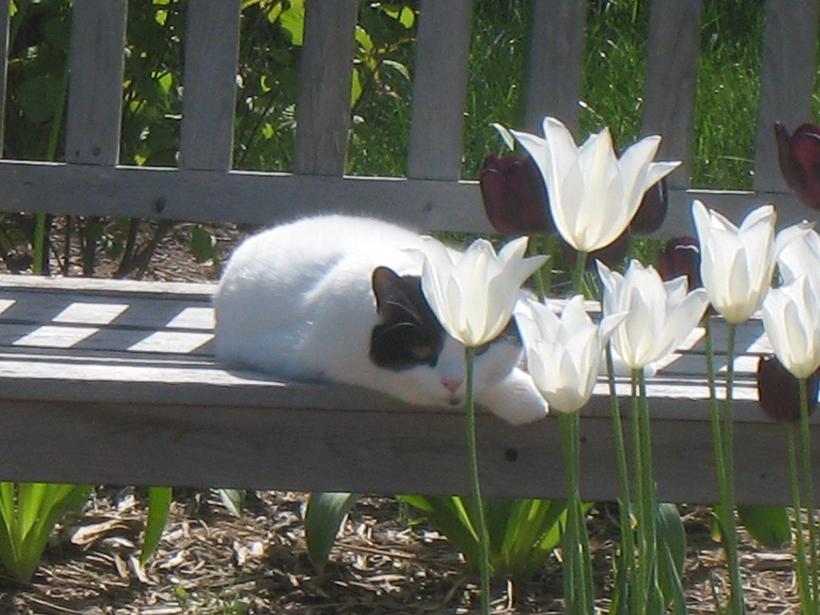
Below you'll find lovely images--particularly when clicked upon and expanded--of prairie smoke seed heads, pasque flower seed heads, some centaurea, allium ripping open, a pressed kitty cat to keep forever, and the same cat with his bro out in the garden before we found a tick on my person so now the cats ain't going out again. (I do not Dr. my images, though since I am a Dr., I suppose, techinically, they are Dr-ed.)
Prairie smoke
Click and expand to see the feathery detail, and to get an idea of what I look like in the morning
Pasque flower, post flower
Allium 'Globemaster'
Centaurea
Pressed kitty
Please-don't-take-me-inside kitty
Stalking-the-bird-feeder kitty
Wednesday, May 12, 2010
Sunday, May 9, 2010
On Mother's Day, Some More of the Memoir
Here are the first few pages of the book, Morning Glory: A Story of Family and Culture in the Garden. Happy Mother's Day to the woman who has given me a green virus that is getting worse and worse each year--thank goodness.
For the last hour I’ve drifted in and out of consciousness, serenaded by the dull drone of a lawnmower and the confusion of where I am: my apartment back in Ohio, the bedroom I had as a child, or my sister’s former room, now my parent’s cramped guest room. It’s ten a.m. and the minor jet lag from a five hour trip is still clearly in my system.
I slide over to the bed’s edge and carefully peel back the blinds. Only one part of the front yard is in sunlight, the thin strip of grass along the street and the eight foot tall rock garden sloping up toward the house. The bed itself stretches from the driveway to the property line, about forty feet, and is scattered with larger stones that are settled in amongst river rock. I see the mower beached on the lawn near the corner of the garden, and like an arrow, a spade’s handle and arm peaking out from the edge of a sugar maple’s dark canopy.
I’ve come home for a visit from grad school where I was working on a masters degree, begged for months to take time out of my writing and teaching, and now that I’m here I’ve woken to an empty house. Downstairs, the shades are up, the sink is full of dirty breakfast dishes, and the windows open to a cool, lingering spring in a June morning damp with the scent of lawn clippings. This was hardly the open-armed visit I’d expected, so I decide to go in search of one, knowing the exact location lies outside.
For years I helped and learned from my mother around the house, literally around—outside in the yard within the borders of less than an acre in the western Minneapolis suburb of Chanhassen. We planted together in the three months a Minnesota summer allows, and my apprenticeship was at times a willing one, but more often than not like forced labor. This meant I never learned much about plant names, cultivars, what would grow and how it would fair in zone four. I did, however, learn how to dig a ten dollar hole for a one dollar plant. In many ways the garden is still a foreign place to me, and my walk through it is part awkwardness and distance from my mother, a woman unknown to me as the flowering perennials.
“Hey, Mom.” I whisper from twenty feet away.
“It’s good to have you home, you know, even if it’s just for a week” she says to the depths of a shrub rose she’s pruning at the base of the rock garden.
“Are we doing anything for lunch?” I ask, wondering if I’m being intrusive, what mood she’s in.
“I don’t know, whatever you want. Hand me that spade, will you?” She stands up, grabs the shovel she’ll soon use to dig another hole, leans on it with her left arm, and wipes her brow with the other. Her pastel green gardening gloves are dark brown at the tips, a pile of already drying weeds and twigs are behind her on a patch of lawn.
“The morning glories don’t even make it to noon, do they,” I comment, turning my attention over to a copper obelisk covered in languid vines and blue-violet blooms hanging limp like popped balloons. These were some of the only flowers I could confidently name.
“No. It’s too hot today. But there sure are more of them this year.” She quickly looks in the other direction, as if she was a pivot sprinkler, and slowly brings herself back from wherever she briefly was. “Just lucky I guess.” She straightens and stretches her legs, lets the shovel fall back behind her, and places her dirt-caked gloves on her hips to lean back and look at the obelisk. “They remind me of my grandma’s house on Spring Street in Racine. She loved flowers, and every time I went over there the house smelled differently depending on the time of day.”
Mom suddenly kneels back down and starts scratching in the rocks, the sound like marbles placed in a cloth bag. Her work is a continuing conversation in itself, so in a way ours hasn’t ended, but it has. She focuses on her next task careful to relish in her alone time. I notice a bumblebee hovering near one deflated morning glory bloom, and with only a moment’s hesitation, it finds its way into the deep well of yellow pollen, gathering what little it could before moving on to the next bloom, and the next, guided by ultraviolet markings neither I nor my mother could see.
For the last hour I’ve drifted in and out of consciousness, serenaded by the dull drone of a lawnmower and the confusion of where I am: my apartment back in Ohio, the bedroom I had as a child, or my sister’s former room, now my parent’s cramped guest room. It’s ten a.m. and the minor jet lag from a five hour trip is still clearly in my system.
I slide over to the bed’s edge and carefully peel back the blinds. Only one part of the front yard is in sunlight, the thin strip of grass along the street and the eight foot tall rock garden sloping up toward the house. The bed itself stretches from the driveway to the property line, about forty feet, and is scattered with larger stones that are settled in amongst river rock. I see the mower beached on the lawn near the corner of the garden, and like an arrow, a spade’s handle and arm peaking out from the edge of a sugar maple’s dark canopy.
I’ve come home for a visit from grad school where I was working on a masters degree, begged for months to take time out of my writing and teaching, and now that I’m here I’ve woken to an empty house. Downstairs, the shades are up, the sink is full of dirty breakfast dishes, and the windows open to a cool, lingering spring in a June morning damp with the scent of lawn clippings. This was hardly the open-armed visit I’d expected, so I decide to go in search of one, knowing the exact location lies outside.
For years I helped and learned from my mother around the house, literally around—outside in the yard within the borders of less than an acre in the western Minneapolis suburb of Chanhassen. We planted together in the three months a Minnesota summer allows, and my apprenticeship was at times a willing one, but more often than not like forced labor. This meant I never learned much about plant names, cultivars, what would grow and how it would fair in zone four. I did, however, learn how to dig a ten dollar hole for a one dollar plant. In many ways the garden is still a foreign place to me, and my walk through it is part awkwardness and distance from my mother, a woman unknown to me as the flowering perennials.
“Hey, Mom.” I whisper from twenty feet away.
“It’s good to have you home, you know, even if it’s just for a week” she says to the depths of a shrub rose she’s pruning at the base of the rock garden.
“Are we doing anything for lunch?” I ask, wondering if I’m being intrusive, what mood she’s in.
“I don’t know, whatever you want. Hand me that spade, will you?” She stands up, grabs the shovel she’ll soon use to dig another hole, leans on it with her left arm, and wipes her brow with the other. Her pastel green gardening gloves are dark brown at the tips, a pile of already drying weeds and twigs are behind her on a patch of lawn.
“The morning glories don’t even make it to noon, do they,” I comment, turning my attention over to a copper obelisk covered in languid vines and blue-violet blooms hanging limp like popped balloons. These were some of the only flowers I could confidently name.
“No. It’s too hot today. But there sure are more of them this year.” She quickly looks in the other direction, as if she was a pivot sprinkler, and slowly brings herself back from wherever she briefly was. “Just lucky I guess.” She straightens and stretches her legs, lets the shovel fall back behind her, and places her dirt-caked gloves on her hips to lean back and look at the obelisk. “They remind me of my grandma’s house on Spring Street in Racine. She loved flowers, and every time I went over there the house smelled differently depending on the time of day.”
Mom suddenly kneels back down and starts scratching in the rocks, the sound like marbles placed in a cloth bag. Her work is a continuing conversation in itself, so in a way ours hasn’t ended, but it has. She focuses on her next task careful to relish in her alone time. I notice a bumblebee hovering near one deflated morning glory bloom, and with only a moment’s hesitation, it finds its way into the deep well of yellow pollen, gathering what little it could before moving on to the next bloom, and the next, guided by ultraviolet markings neither I nor my mother could see.
Tuesday, May 4, 2010
Napping Tulips and Shooting Stars
The tulips look so cute together (below). And my shooting stars are finally growing up; last year I was freaked out when they went dormant, thinking they had died. Why is it that when I go dormant, people think I've died? Maybe I should go dormant more often? How do you go dormant? Why does "dormant" sound a lot like "door mat?"
Rain-stained tulips (which are a good week early this year)
Shooting star of some kind--the species?
Shooting star, I forget the cultivar
Cornus 'Arctic Fire' still has red stems as it flowers--white berries soon to come (and then the birds get them within 5 seconds).
Last weekend the wife and I hit Spring Affair, an annual local 45,000 plant sale. And then a week later went to the Nebraska Statewide Arboretum sale. Spring has been good (though too warm and windy to have kept the flowering trees looking good for more than 2 days).
Ah, young love.
Rain-stained tulips (which are a good week early this year)
Shooting star of some kind--the species?
Shooting star, I forget the cultivar
Cornus 'Arctic Fire' still has red stems as it flowers--white berries soon to come (and then the birds get them within 5 seconds).
Well, here's to summer then, and hopefully rewriting 70 or so pages of my garden memoir, and getting it right this time, because a ton of literary agents got hooked but none bit (and perhaps for good reason). No idea where the energy will come from, or how I can possibly get into writing mode again, but it's a lot like working out--including the sweating, the grunting, the smells, and the bouncy / jiggly bits (maybe not so much for men, but stuff still gets in the way).
Monday, May 3, 2010
Poetry Giveaway Winners
Randomly generated winners are:
Diane Lockwood
Layanee DeMerchant
Carl Palmer
Suzanne Frischkorn
They can fight it out between Komunyakaa, Gluck, Vogt, and Campo.
I'm going to have another giveaway--my sanity. Details forthcoming (once grading finals is over).
Diane Lockwood
Layanee DeMerchant
Carl Palmer
Suzanne Frischkorn
They can fight it out between Komunyakaa, Gluck, Vogt, and Campo.
I'm going to have another giveaway--my sanity. Details forthcoming (once grading finals is over).
Sunday, April 25, 2010
Exhibit A-Z for Not Having Lawn
I rest my case. I also rest my camera, poor thing is plum (crabapple?) tired.
Praire Fire crabapple, with a Fineline buckthorn flanking the path
Mystery white crabapple from Arbor Day, 1st year in bloom
Prairie Smoke, which so far only the queen bumble bees have been working on
Prairie Fire crab
Chokecherry, Canada Red (leaves come out green, turn plum)
Lots of plants
Lots lots lots of plants
River birch seeds
Tulips, yes, I do believe, tulips
Gold-leaved smokebush
Yesterday the wife and I hit the annual Spring Affair plant sale, sponsored by the Nebraska Arboretum (UNL). Crazy as always. 100s, likely 1000 bodies all at once hitting you with their cardboard flats, no one looking where they are going, slow people, fast people with little regard for others (me). Lovely, though. Lovely every year. I got the last of the milkweed.
Praire Fire crabapple, with a Fineline buckthorn flanking the path
Mystery white crabapple from Arbor Day, 1st year in bloom
Prairie Smoke, which so far only the queen bumble bees have been working on
Prairie Fire crab
Chokecherry, Canada Red (leaves come out green, turn plum)
Lots of plants
Lots lots lots of plants
River birch seeds
Tulips, yes, I do believe, tulips
Gold-leaved smokebush
Yesterday the wife and I hit the annual Spring Affair plant sale, sponsored by the Nebraska Arboretum (UNL). Crazy as always. 100s, likely 1000 bodies all at once hitting you with their cardboard flats, no one looking where they are going, slow people, fast people with little regard for others (me). Lovely, though. Lovely every year. I got the last of the milkweed.
Then we hit some nurseries. Found the most majestic weeping mulberry, but they wanted to charge $75 for delivery. Other local nurseries charge $10-20. Had the perfect spot for the mulberry, but the budget dictated I become like every other American and go to Home Depot and buy a $40 white-blooming crabapple instead. I'm sorry. I do buy the vast bulk of my plants from the local folks. Why am I defending myself to you? I bet you do the same thing.
Said local nursery also had a cool tree form of buckthorn. Wowsers.
Thursday, April 22, 2010
Anal Scraping--Would You Do It?
Some evolutionarily younger caterpillars use their butts to warn off others. "To defend their territory and keep out intruders, the larvae can wear one of at least two hats: tough-guy bully or sophisticated orator. The former lets an intruder know who's boss with aggressive maneuvering, crawling up to the enemy, pushing and biting to try to evict it from a leaf. The civilized talker instead scrapes its rear on the leaf, sending out vibration signals saying the equivalent of 'You better leave now, or else.' These more posh caterpillars also use their mouth parts to drum on the leaf and scrape across the leaf's surface."
"'We conclude that the anal scraping movement is a modified component of crawling, and that instead of moving forward, D. arcuata walks on the spot, to talk,' lead author Jaclyn Scott of Carleton University and colleagues write in the April 12 issue of the journal Nature Communications." [Oh, caterpillars also moon walk! Sweet!]
"Another idea is that the vibrations from the scraping and drumming are so loud they attract birds on the hunt for meaty insects. And the resident has a little silken shelter and might be telling the intruder, 'I'm making a racket here so if you want to take cover you better take off.'"
Full article here.
Happy Earth Day!
"'We conclude that the anal scraping movement is a modified component of crawling, and that instead of moving forward, D. arcuata walks on the spot, to talk,' lead author Jaclyn Scott of Carleton University and colleagues write in the April 12 issue of the journal Nature Communications." [Oh, caterpillars also moon walk! Sweet!]
"Another idea is that the vibrations from the scraping and drumming are so loud they attract birds on the hunt for meaty insects. And the resident has a little silken shelter and might be telling the intruder, 'I'm making a racket here so if you want to take cover you better take off.'"
Full article here.
Happy Earth Day!
Monday, April 19, 2010
Let 6 Months of Mowing Hell Commence
Mr. Mows All The Time mowed this morning. He mowed on Wednesday or Thursday of last week. It hasn't rained here in I can't remember how long. So, how much plutonium is he using to justify mowing twice a week, as he will do until hell, er, the lawns freeze over in late October?
Yesterday my wife went to read on the garden bench in the morning. Read with an iPod even. She came in because our neighbor to the right began mowing his lawn.
Then as I was grilling dinner, the neighbor to the left mowed her lawn. Peaceful tranquility, let me tell you. I so enjoy the garden.
Saturday morning I was grading essays at the kitchen table, and slid open the porch door to some lovely weather. Within 10 minutes the back neighbor, on 3 acres, comes plodding along on his sit-down mower--WITH GIANT EAR PROTECTORS ON (like you'd see, oh, on aircraft carriers). What does that tell you? He had to mow his weeds, and I got to close my door and breathe my polluted indoor air.
This nonstop buzzing and whirling has me going insane. Two of my neighbors, including Mr. Mows All The Time, complete their 45-60 minute mowing cycles with blowing lawn clippings around. Mind you, we have 20-30mph winds quite often that cleanly and cheaply blow these clippings back on to the lawn.
Sometimes, I feel like the sooner we kill ourselves the better off the few of us left behind might be in the long run. That's a bad way to look at things, I know. Do people really enjoy mowing their lawn? Is this leisure time, connect with nature time, joie de vivre? Spewing stats at people does nothing--we have to feel the problem, emotionally. I need to figure this out. I'm tired of living an emotionally / culturally / socially constipated life.
Yesterday my wife went to read on the garden bench in the morning. Read with an iPod even. She came in because our neighbor to the right began mowing his lawn.
Then as I was grilling dinner, the neighbor to the left mowed her lawn. Peaceful tranquility, let me tell you. I so enjoy the garden.
Saturday morning I was grading essays at the kitchen table, and slid open the porch door to some lovely weather. Within 10 minutes the back neighbor, on 3 acres, comes plodding along on his sit-down mower--WITH GIANT EAR PROTECTORS ON (like you'd see, oh, on aircraft carriers). What does that tell you? He had to mow his weeds, and I got to close my door and breathe my polluted indoor air.
This nonstop buzzing and whirling has me going insane. Two of my neighbors, including Mr. Mows All The Time, complete their 45-60 minute mowing cycles with blowing lawn clippings around. Mind you, we have 20-30mph winds quite often that cleanly and cheaply blow these clippings back on to the lawn.
Sometimes, I feel like the sooner we kill ourselves the better off the few of us left behind might be in the long run. That's a bad way to look at things, I know. Do people really enjoy mowing their lawn? Is this leisure time, connect with nature time, joie de vivre? Spewing stats at people does nothing--we have to feel the problem, emotionally. I need to figure this out. I'm tired of living an emotionally / culturally / socially constipated life.
Wednesday, April 14, 2010
Vomit Green, Lizard Green, Green Green
Here's a bit from the memoir, Morning Glory, recounting trips to the nursery with my Mom when I was a kid.
With no specific day, with no specific event marking it as extraordinary, I remember this from my childhood: tagging along with my mother to go to the nursery. Somewhere around the age of twelve or thirteen I did this several times over the summer, getting up “early” around nine or ten to tackle the manmade jungle among rows sheltered by half-translucent green plastic overhead.
Nurseries are strange places. The consumer itch for immediacy and razzle-dazzle meets the relatively naïve and simplistic beauty of plants becoming themselves. I’ve never known a good nursery to be modern and chic, either. By this I mean pulling into the parking lot and being wowed by clean, simplistic lines of design, the less is more strategy. In fact, I’ve never known a nursery that’s had a paved parking lot, or a parking lot that could accommodate more than a dozen or so cars. Even before you make it to the door—an arbor covered in clematis or ivy—the idea that your world is really not yours hits home. The pathways between the rows of wet-leafed plants from the morning watering are covered in thick mulch. When I went along with my mother on big shopping days, I had to pull the nursery-provided red-flyer along through the mulch. At first, being a skinny teenager wasn’t so bad—the wagon rolled along somewhat easily across the wood. Later, as the plants accumulated and as the black plastic containers grew larger, I’d find myself several rows over from my mother trying to diligently trace her snakelike path.
“Benj, where are you. C’mon up here so I can put these flowers in the cart.”
“I’m coming Mom.” She winces, turns not just her head but her whole body, and meets the cart halfway plopping the plants into the metal din of the cart.
“You’ve got to keep up with me. I need your help.” She didn’t smile, but turned back and faded into the turns of another row—I knew I’d never catch up with her. We’d have this conversation a few more times before the morning was out and eventually, planting in the garden, I’d either be forgiven and she’d let me do the planting, or I’d be rejected into the artificial air of my cool bedroom and video games.
The name of the garden center I remember most is, appropriately, The Garden Patch. It was a twenty to thirty minute drive because my mother didn’t like ones closer to our house. This nursery was off the side of a relatively busy, two lane county highway in the southern suburb of Shakopee. As cars pulled off into the dirt parking lot they had to make a considerable effort to slow down, so traffic behind became briefly bottle-necked. But approach the lot too fast and you might hit a pool of mud and get stuck, or knock out your shocks from the un-graded moon-like landscape.
This plant refectory reeked of dampness, protein, soil nutrients, stale un-circulated air and the people who worked the sticky brown cash register. Just inside the front arbor were two lines of twenty red-flyer wagons, lined up like shopping carts but tantalizingly playful. The first row of plants, small ornamental trees, pines and maples, shade plants, was relatively wide and open—inviting like a great hall or a mansion’s entryway. But once through, the rows split left and right and were so narrow no two wagons could pass by one another. My mother stood obliviously among them as I constantly had to angle out and make way for another poor child’s laborious route behind his mother.
But even though the load became progressively worse, there was a solemn joy and sense of purpose that emanated from the rows of artificially grown plants. My mother would thumb through stacks of annuals as if it were a recipe book, and I would patiently wait a few feet behind, if I’d caught up, fingering leaves of nearby plants, letting drips of water collect in the middle and slide down the tip, off into the mulch below. As Mom decided which plants would work in what amount of sunlight and in what soil and what time of year, I became mesmerized by the shades of green accented by the black plastic shadows: light green, dark green, silver green, frothy green, milky green, brilliant green, lizard green, vomit green, soft green, prickly green, green green… it was too much and not enough at once. Even the idea of all that life in such a small space is intoxicating and numbing.
How could all these plants thrive in this small space, and would they, like old lettuce in the grocery store, be tossed away if not bought before their roots outgrew their containers? When I walk through a forest or a dense park I always get dizzy—there’s too much to sense and observe that it becomes overwhelming. I can’t stop every few feet to observe a stone or branch because I’d never make it home in time for the next millennium; and if I stop for an hour or two just to take in the sense of one space and map it, really listen and look, I feel I’d miss 99.9% of what’s there.
These aisles, my mother’s patient discoveries, the weight of my cart, warm green light transfusing around it all, the thick smell of soil—a person might drown. Where is the car, the asphalt road, the brick and stucco buildings selling lawnmowers and chainsaws, the Minneapolis skyscrapers trumping the natural world around them a hundred fold. Where are the open, sterile spaces of man’s dominance that sets me free, the reliable highway arteries and overpasses and cloverleaves slapped down firm upon knocked down woods and open grasslands. In those nurseries I relished in the depth and intensity of life and becoming, of color and detail, I sank in the damp mulch and felt the bottoms of my feet warming in the insulation.
But just as much I craved the release of artificiality, as if among life and living I had held my breath until I passed through it—just as we’d do on the school bus when it passed through the Lowry tunnel downtown, underneath the Walker’s outdoor sculpture garden. Somewhere between the nursery, the car’s full trunk, and the plants huddled on the grass beside the garage, I exhaled and wanted to breathe in again, wanted to go back to the nursery. It was, in a strange way, thrilling—deprived of nature and over compensated with it. I couldn’t wait until early evening when we’d move through the garden slowly like maple shadows and find our way again.
With no specific day, with no specific event marking it as extraordinary, I remember this from my childhood: tagging along with my mother to go to the nursery. Somewhere around the age of twelve or thirteen I did this several times over the summer, getting up “early” around nine or ten to tackle the manmade jungle among rows sheltered by half-translucent green plastic overhead.
Nurseries are strange places. The consumer itch for immediacy and razzle-dazzle meets the relatively naïve and simplistic beauty of plants becoming themselves. I’ve never known a good nursery to be modern and chic, either. By this I mean pulling into the parking lot and being wowed by clean, simplistic lines of design, the less is more strategy. In fact, I’ve never known a nursery that’s had a paved parking lot, or a parking lot that could accommodate more than a dozen or so cars. Even before you make it to the door—an arbor covered in clematis or ivy—the idea that your world is really not yours hits home. The pathways between the rows of wet-leafed plants from the morning watering are covered in thick mulch. When I went along with my mother on big shopping days, I had to pull the nursery-provided red-flyer along through the mulch. At first, being a skinny teenager wasn’t so bad—the wagon rolled along somewhat easily across the wood. Later, as the plants accumulated and as the black plastic containers grew larger, I’d find myself several rows over from my mother trying to diligently trace her snakelike path.
“Benj, where are you. C’mon up here so I can put these flowers in the cart.”
“I’m coming Mom.” She winces, turns not just her head but her whole body, and meets the cart halfway plopping the plants into the metal din of the cart.
“You’ve got to keep up with me. I need your help.” She didn’t smile, but turned back and faded into the turns of another row—I knew I’d never catch up with her. We’d have this conversation a few more times before the morning was out and eventually, planting in the garden, I’d either be forgiven and she’d let me do the planting, or I’d be rejected into the artificial air of my cool bedroom and video games.
The name of the garden center I remember most is, appropriately, The Garden Patch. It was a twenty to thirty minute drive because my mother didn’t like ones closer to our house. This nursery was off the side of a relatively busy, two lane county highway in the southern suburb of Shakopee. As cars pulled off into the dirt parking lot they had to make a considerable effort to slow down, so traffic behind became briefly bottle-necked. But approach the lot too fast and you might hit a pool of mud and get stuck, or knock out your shocks from the un-graded moon-like landscape.
This plant refectory reeked of dampness, protein, soil nutrients, stale un-circulated air and the people who worked the sticky brown cash register. Just inside the front arbor were two lines of twenty red-flyer wagons, lined up like shopping carts but tantalizingly playful. The first row of plants, small ornamental trees, pines and maples, shade plants, was relatively wide and open—inviting like a great hall or a mansion’s entryway. But once through, the rows split left and right and were so narrow no two wagons could pass by one another. My mother stood obliviously among them as I constantly had to angle out and make way for another poor child’s laborious route behind his mother.
But even though the load became progressively worse, there was a solemn joy and sense of purpose that emanated from the rows of artificially grown plants. My mother would thumb through stacks of annuals as if it were a recipe book, and I would patiently wait a few feet behind, if I’d caught up, fingering leaves of nearby plants, letting drips of water collect in the middle and slide down the tip, off into the mulch below. As Mom decided which plants would work in what amount of sunlight and in what soil and what time of year, I became mesmerized by the shades of green accented by the black plastic shadows: light green, dark green, silver green, frothy green, milky green, brilliant green, lizard green, vomit green, soft green, prickly green, green green… it was too much and not enough at once. Even the idea of all that life in such a small space is intoxicating and numbing.
How could all these plants thrive in this small space, and would they, like old lettuce in the grocery store, be tossed away if not bought before their roots outgrew their containers? When I walk through a forest or a dense park I always get dizzy—there’s too much to sense and observe that it becomes overwhelming. I can’t stop every few feet to observe a stone or branch because I’d never make it home in time for the next millennium; and if I stop for an hour or two just to take in the sense of one space and map it, really listen and look, I feel I’d miss 99.9% of what’s there.
These aisles, my mother’s patient discoveries, the weight of my cart, warm green light transfusing around it all, the thick smell of soil—a person might drown. Where is the car, the asphalt road, the brick and stucco buildings selling lawnmowers and chainsaws, the Minneapolis skyscrapers trumping the natural world around them a hundred fold. Where are the open, sterile spaces of man’s dominance that sets me free, the reliable highway arteries and overpasses and cloverleaves slapped down firm upon knocked down woods and open grasslands. In those nurseries I relished in the depth and intensity of life and becoming, of color and detail, I sank in the damp mulch and felt the bottoms of my feet warming in the insulation.
But just as much I craved the release of artificiality, as if among life and living I had held my breath until I passed through it—just as we’d do on the school bus when it passed through the Lowry tunnel downtown, underneath the Walker’s outdoor sculpture garden. Somewhere between the nursery, the car’s full trunk, and the plants huddled on the grass beside the garage, I exhaled and wanted to breathe in again, wanted to go back to the nursery. It was, in a strange way, thrilling—deprived of nature and over compensated with it. I couldn’t wait until early evening when we’d move through the garden slowly like maple shadows and find our way again.
Monday, April 12, 2010
His Wife -- Poem by Andrew Hudgins
My wife is not afraid of dirt.
She spends each morning gardening,
stooped over, watering, pulling weeds,
removing insects from her plants
and pinching them until they burst.
She won't grow marigolds or hollyhocks,
just onions, eggplants, peppers, peas –
things we can eat. And while she sweats
I'm working on my poetry and flute.
Then growing tired of all that art,
I've strolled out to the garden plot
and seen her pull a tomato from the vine
and bite into the unwashed fruit
like a soft, hot apple in her hand.
The juice streams down her dirty chin
and tiny seeds stick to her lips.
Her eye is clear, her body full of light,
and when, at night, I hold her close,
she smells of mint and lemon balm.
She spends each morning gardening,
stooped over, watering, pulling weeds,
removing insects from her plants
and pinching them until they burst.
She won't grow marigolds or hollyhocks,
just onions, eggplants, peppers, peas –
things we can eat. And while she sweats
I'm working on my poetry and flute.
Then growing tired of all that art,
I've strolled out to the garden plot
and seen her pull a tomato from the vine
and bite into the unwashed fruit
like a soft, hot apple in her hand.
The juice streams down her dirty chin
and tiny seeds stick to her lips.
Her eye is clear, her body full of light,
and when, at night, I hold her close,
she smells of mint and lemon balm.
Sunday, April 11, 2010
Bodies -- Poem by Jude Nutter
The foxgloves begin that flickering
descent away from themselves, out
of the visible world: all summer
the narrow sheaths of their flowers
unfurl and the bees, drawn always
by the suck of quiet blooming, arrive
at each slow secret as it rides there
on the thin flame of its stem. And every
flower is bruised hollow with light
and for a while they ignite like the naves
of churches. No wonder the bees
keep nudging beyond the smooth clutch
of the petals and into the widening emptiness
inside those flowers, on fire
with the only burning that counts.
descent away from themselves, out
of the visible world: all summer
the narrow sheaths of their flowers
unfurl and the bees, drawn always
by the suck of quiet blooming, arrive
at each slow secret as it rides there
on the thin flame of its stem. And every
flower is bruised hollow with light
and for a while they ignite like the naves
of churches. No wonder the bees
keep nudging beyond the smooth clutch
of the petals and into the widening emptiness
inside those flowers, on fire
with the only burning that counts.
Saturday, April 10, 2010
I Know Nutting!
Not much going on here. Wouldn't waste your time reading this post. Nope. Just same ole same ole. Trying to get along, trying to keep the grey-haired head above water. Running the rat race, for nothing.
Still not much happening. Someone mowed their lawn this morning. Annoying. Loud. Someone left their dog out all night. Ditto. Ditto.
Ho hum. Lots to do professionally, don't want to do it = career suicide. Would like a nap. Watch A-Team over and over or some other dumb 80s show.
Not much going on here. Still reading? This is my most cerebral post in years. End of semester brain-dead-ness alive and well (which means, I think, that I become a better teacher as I become more entertaining in class, i.e. chaotic, whimsical).
Oh. Anyone have any luck planting trees at an angle, on purpose? Or, anyone have luck pruning trees to grow in just one or two directions? Talking small, understory trees of 15-20' in height.
Still not much happening. Someone mowed their lawn this morning. Annoying. Loud. Someone left their dog out all night. Ditto. Ditto.
Ho hum. Lots to do professionally, don't want to do it = career suicide. Would like a nap. Watch A-Team over and over or some other dumb 80s show.
Not much going on here. Still reading? This is my most cerebral post in years. End of semester brain-dead-ness alive and well (which means, I think, that I become a better teacher as I become more entertaining in class, i.e. chaotic, whimsical).
Oh. Anyone have any luck planting trees at an angle, on purpose? Or, anyone have luck pruning trees to grow in just one or two directions? Talking small, understory trees of 15-20' in height.
Wednesday, April 7, 2010
Pasque Flower Power Rangers
I am going nuts this week. Here's a blog post with two pictures. That's as eloquent as I can muster today. Which might be enough to get some of us through the day. I hope.
Thursday, April 1, 2010
Poetry Book Giveaway
April is national poetry month, and I will be sending out free books to anyone who leaves a comment to this post by April 30 (your comment might also rank the books in order of desire / lust). I will randomly choose the winner (or winners, maybe one book per winner?) on May 1 if I'm not too busy grading finals. The below are some of my favorite books, one for obvious reasons.
The Wild Iris by Louise Gluck
Lush, lyrical persona poems on flowers, plants, times of day, prayers.
What the Body Told by Rafael Campo
Gay physician, father, Cuban-American, reinvents formal poetry for the 21st century in gritty and moving imagery.
Dien Cai Dau by Yusef Komunyakaa
The best poetry collection on the Vietnam War experience ever, and by a good poet to boot.
Indelible Marks by Benjamin Vogt
My first chapbook. It's ok. There are two poems I'd like to cut. The second chap, forthcoming this October, will be better.
Thanks to Kelli Russell Agodon for instigating this idea for poet bloggers (I am a poet / nonfiction / garden / environmental / whiney blogger).
Wednesday, March 24, 2010
Cover for the Poetry Chapbook
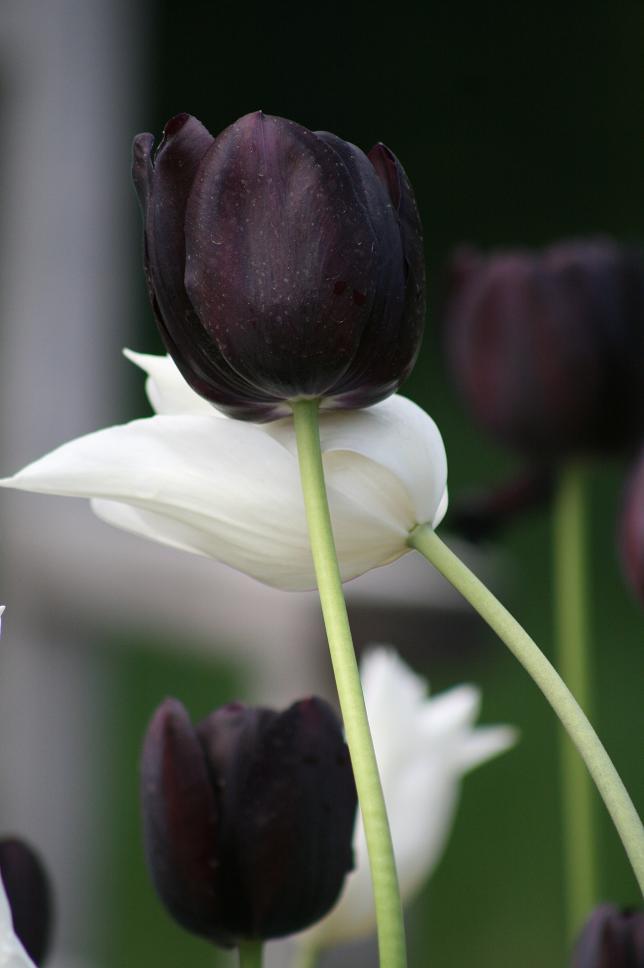
They usually aren't nearly as sexy as full length books, but my 2nd chapbook, Without Such Absence, will be in color--which is like having black tulips in the garden. We all know how black tulips are. Don't we. Oh yeah.
So below is an approximation of the cover. Prepub sales aren't until August, and the book itself won't appear until late October, but you may want to start saving up now for the $14 cover price. I feel like a writer for a little while. (Now someone please publish the full length poetry collection and the memoir!)
That image would be of the chicken coop from my dad's very early boyhood homestead in Oklahoma. No chickens in there now, just rolls and rolls of barbed wire (which could be reproducing--it's likely, actually).
So below is an approximation of the cover. Prepub sales aren't until August, and the book itself won't appear until late October, but you may want to start saving up now for the $14 cover price. I feel like a writer for a little while. (Now someone please publish the full length poetry collection and the memoir!)
That image would be of the chicken coop from my dad's very early boyhood homestead in Oklahoma. No chickens in there now, just rolls and rolls of barbed wire (which could be reproducing--it's likely, actually).
Sunday, March 21, 2010
Spring. Winter. Sprinter. Wring. Swipringter.
Saturday, March 20, 2010
Rant--Memoir #2 Research Trip to Hell, Er, Kansas
In the last year I've made exponential leaps in understanding the writing life. Well, not exponential--more like concrete affirmations, as in, bang your head against concrete affirmations. Writing is like whipping yourself, it's masochistic, it's like jumping into quicksand. Why do I do this to myself? What, exactly, is the point? The payoff? Why must I be so meticulous? Why is writerly process more like my being processed by a meat grinder?
Last Sunday I left for Wichita, KS to research my family's immigration to Kansas in 1874-1879, planning to use the Mennonite Library and Archive in Newton and visit some ancestral churches (Hoffnungsau, Alexanderwohl, Bergthal).
Halfway there, in Concordia, my back left tire blew at 70mph. Luckily, it happened right in front of the volunteer fire chief's house, and he exhuberantly put on my spare for me. Something punctured the tire. It was terrifying, and I drove on edge the rest of the week.
The only tire place that is open is a mini Walmart-esque place for farmers--they don't have the right tire size. I concede and head to the Holiday Inn to get a room, knowing I lose a day of research. The nice receptionist hooks me up with an after hours tire service. Said service guy tells me upon inspecting my lug and bolts that the fire chief did not thread the bolts correctly into the hub--actually stripped the threads--and he worked hard to get 4 of the 5 to screw in, suggesting I shouldn't even drive on 4, and that it'd take a day or two to get a 5th.
I drove to Wichita anyway. 4 hour trip is now 8. Stopped twice to make sure the bolts were tight. Monday morning I spent 2 hours at the car dealership getting 5 new lug bolts, and finding out I was lucky that the lug threads were fine, cuz that would've been $1,000 for a new lug. So far, I'm only up to $450 in tire expenses.
Wednesday morning my engine light comes on. Back to the Wichita dealership after just driving to Newton (35 minutes one way). An air hose, that helps mix the fuel or something, has cracked and could've lead to the engine, well, seizing. Soon. Luckily this fix was free, but I'd wasted an entire afternoon messing with my car, again.
As for the research itself I made NO HEADWAY at all. Dead end after dead end after dead end. All the sources I wanted to see were not helpful. Even my great great great grandmother was not buried in the cemetary she was reported to be buried in, and I was not going to spend a week searching county records and cemetaries, nor was I going to hire a forensics team to dig up the church plots. My family is lost, in great measure, so when I see someone burning down an old church or razing an old barn or farmhouse, I get mightily pissed. In America, we sure do love to erase ourselves. I think some call it progress. I call it cultural alzheimers.
I ended my trip early, retreated home.
Back in 2006 in Wichita, at a toll booth, an RV sideswiped my car cuz the driver couldn't decide which toll lane he wanted (he'd never driven an RV before, and had no insurance). Much of my car was bent, ripped off, concave. This happened a few days after my grandmother's funeral in Oklahoma, on my way back to Nebraska. I don't care for Wichita.
Point is--$^%*&@^!!. I think the best a person can do with this sort of book project is just cull together what one can from more famous people who shared the boat ride over, shared the homesteading experience, and pretend it's your family--a bunch of relative nobodies who had little money and rented farms until 1884-ish, yet transformed the plains into a completely new landscape in 10 years. Maybe I can compare my road trip to fixing a schooner wheel as a tornado or prairie fire or bison heard approaches.
It's time to move on, and maybe come back to family months later. It's time to research Mennonite missionaries in Oklahoma, the Cheyenne and Arapaho tribes, government policy towards them in Oklahoma territory, and the changing ecology of the most diverse state in the union. At least I'll make some headway. Right?
Last Sunday I left for Wichita, KS to research my family's immigration to Kansas in 1874-1879, planning to use the Mennonite Library and Archive in Newton and visit some ancestral churches (Hoffnungsau, Alexanderwohl, Bergthal).
Halfway there, in Concordia, my back left tire blew at 70mph. Luckily, it happened right in front of the volunteer fire chief's house, and he exhuberantly put on my spare for me. Something punctured the tire. It was terrifying, and I drove on edge the rest of the week.
The only tire place that is open is a mini Walmart-esque place for farmers--they don't have the right tire size. I concede and head to the Holiday Inn to get a room, knowing I lose a day of research. The nice receptionist hooks me up with an after hours tire service. Said service guy tells me upon inspecting my lug and bolts that the fire chief did not thread the bolts correctly into the hub--actually stripped the threads--and he worked hard to get 4 of the 5 to screw in, suggesting I shouldn't even drive on 4, and that it'd take a day or two to get a 5th.
I drove to Wichita anyway. 4 hour trip is now 8. Stopped twice to make sure the bolts were tight. Monday morning I spent 2 hours at the car dealership getting 5 new lug bolts, and finding out I was lucky that the lug threads were fine, cuz that would've been $1,000 for a new lug. So far, I'm only up to $450 in tire expenses.
Wednesday morning my engine light comes on. Back to the Wichita dealership after just driving to Newton (35 minutes one way). An air hose, that helps mix the fuel or something, has cracked and could've lead to the engine, well, seizing. Soon. Luckily this fix was free, but I'd wasted an entire afternoon messing with my car, again.
As for the research itself I made NO HEADWAY at all. Dead end after dead end after dead end. All the sources I wanted to see were not helpful. Even my great great great grandmother was not buried in the cemetary she was reported to be buried in, and I was not going to spend a week searching county records and cemetaries, nor was I going to hire a forensics team to dig up the church plots. My family is lost, in great measure, so when I see someone burning down an old church or razing an old barn or farmhouse, I get mightily pissed. In America, we sure do love to erase ourselves. I think some call it progress. I call it cultural alzheimers.
I ended my trip early, retreated home.
Back in 2006 in Wichita, at a toll booth, an RV sideswiped my car cuz the driver couldn't decide which toll lane he wanted (he'd never driven an RV before, and had no insurance). Much of my car was bent, ripped off, concave. This happened a few days after my grandmother's funeral in Oklahoma, on my way back to Nebraska. I don't care for Wichita.
Point is--$^%*&@^!!. I think the best a person can do with this sort of book project is just cull together what one can from more famous people who shared the boat ride over, shared the homesteading experience, and pretend it's your family--a bunch of relative nobodies who had little money and rented farms until 1884-ish, yet transformed the plains into a completely new landscape in 10 years. Maybe I can compare my road trip to fixing a schooner wheel as a tornado or prairie fire or bison heard approaches.
It's time to move on, and maybe come back to family months later. It's time to research Mennonite missionaries in Oklahoma, the Cheyenne and Arapaho tribes, government policy towards them in Oklahoma territory, and the changing ecology of the most diverse state in the union. At least I'll make some headway. Right?
Wednesday, March 17, 2010
Gnaw, I Didn't Eat Yer Shrubs This Winter
Way more snow = way more rabbit damage, as seen below. We'll discover how adroit I am at trimming and shaping shrubs soon enough.
'Tiger Eyes' Sumac looks to be in trouble. Will new branches just ignore this and still grow out, even if the nodes or whatever are gone?
The willow will look more like a pillar than a nice round shrub once I try to even it out, at least until mid summer.
A 3 foot tall red chokeberry is now 18 inches. I'm starting over since they grow so painfully slow anyway.
A burning bush relegated to behind the a/c unit lost half its je ne sais quoi.
And how quickly one forgets the 3-4 foot snow drifts, until one looks at the gnawed off crabapple branch about, oh, 4-5 feet off the ground.
Finally, you would not believe--you can not imagine--just how much rabbit crap is everywhere. I do not look forward to kneeling in the garden this spring. Over by the willow you can't see mulch. Seriously. I forgot to take a picture, but just imagine if someone dumped gallons of M&Ms in your living room. No, the rabbit did not poop in blue or red or yellow, but I wish he had. I could pretend it were flowers. Or Wonka Land. Or a pick up game of marbles. Or [insert your witty remark here, and if you don't wit, it won't please anyone a whit].
Garfield Minus Garfield sums up today's post:
'Tiger Eyes' Sumac looks to be in trouble. Will new branches just ignore this and still grow out, even if the nodes or whatever are gone?
The willow will look more like a pillar than a nice round shrub once I try to even it out, at least until mid summer.
A 3 foot tall red chokeberry is now 18 inches. I'm starting over since they grow so painfully slow anyway.
A burning bush relegated to behind the a/c unit lost half its je ne sais quoi.
And how quickly one forgets the 3-4 foot snow drifts, until one looks at the gnawed off crabapple branch about, oh, 4-5 feet off the ground.
Finally, you would not believe--you can not imagine--just how much rabbit crap is everywhere. I do not look forward to kneeling in the garden this spring. Over by the willow you can't see mulch. Seriously. I forgot to take a picture, but just imagine if someone dumped gallons of M&Ms in your living room. No, the rabbit did not poop in blue or red or yellow, but I wish he had. I could pretend it were flowers. Or Wonka Land. Or a pick up game of marbles. Or [insert your witty remark here, and if you don't wit, it won't please anyone a whit].
Garfield Minus Garfield sums up today's post:
Thursday, March 11, 2010
Extinction--Oklahoma, Flora, Fauna, & Culture
Last night I went to hear a friend / colleague / previous PhD committee member (has it almost been a year since I graduated?) read from his new book, Pieces of the Plains. John Janovy is a biologist, so his perspective on life is much different than mine--microscopic (studies parasites and such) and lots of method. Lots of being in the trenches. He was also born (as was I) and educated in Oklahoma, which is the subject of my next book. But more on that later.
Janovy was asked about the current extinctions we are beginning to witness of species, and if he saw a curtailing of that being possible. No, he said flat out, no, no way--not with how humans kill each other, not with how we kill for oil and in the name of god. Then he told the college students there that when they reach his age, in about 50 years, they'd be living in a far different world of hunger, lack of water, homelessness, global government chaos--all as oil runs out. I got that from watching a recent episode of World Without Oil on National Geographic (title?). It was frightening and only the tip of the berg.
Back to extinctions. I am still young, I still have some hope, but it's dwindling fast. Janovy said he is in the top 1% of humans who ever lived that have witnessed such natural diversity on earth, and that such diversity will very shortly come to an end, so enjoy it while you can. Species will weaken as the gene pool shrinks.
We've had other significant, 90th percentile global extinctions, but this 6th one as many folks call it--even if overcome--would take millions of years to repair, to evolve back to what we see now on the planet. It took millions of years before, it will again, if it happens.
I wonder if I should spend every waking chance I have to sit on my deck listening to the cardinals, blue jays, finches, sparrows, mourning doves and others before they vanish. 1% of bird species go functionally extinct each year. I wonder if I should sell my house and buy those 100 acres now and live in a tent so I can enjoy and interact more fully with nature while it is still here. I wonder if our natural descriptions today will seem as foreign to someone in a few decades as the pioneer descriptions I read of buffalo and elk wandering through wheat fields.
I wonder if this all has to be so dark. Humans are like my students and procrastinate until the last minute, until they have no choice but to do the work. I wonder if that's genetic, or if it's the same old song and dance of capitalism, of self-preservation, of blah blah blah.
I wonder if my next book will matter, if I should even write it. Last night Janovy quoted Oklahoma historian Angie Debo, whose 1930-ish work slapped the country's collective face as to Indian policy in Oklahoma territory and its early statehood years. Keep in mind, in 1930, many folks who instigated those policies were still very much alive. I quote her:
"Oklahoma is more than just another state. It is a lens in which the long rays of time are focused into the brightest of light. In its magnifying clarity, dim facets of the American character stand more clearly revealed. For in Oklahoma all the experiences that went into the making of the nation have been speeded up. Here all the American traits have been intensified. The one who can interpret Oklahoma can grasp the meaning of America in the modern world."
As I look at the history of my Mennonite family coming over from Germany and Russia in the 1870s, I am caught in an impossible vice: their faith, hope, and work ethic was unique, was incredible, was and is so praise worthy I can't put it into words. And yet, either as government pawns and / or willing paticipants through missionary work in Oklahoma territory, they helped to so efficiently destroy the ecology of native flora and fauna and dozens of Native American cultures within a few decades--if not within one decade.
This very fine line scares the heck out of me, and I have to have faith that as I continue to research books and family stories, it will play itself out in the right way--without guilt, blame, or condemnation, but with honest and direct light, and somehow with the same hope and faith my ancestors had facing a world of incredible uncertainty. Phase 2 begins next week.
P.S. -- It's snowing hard outside. That doesn't help things.
Janovy was asked about the current extinctions we are beginning to witness of species, and if he saw a curtailing of that being possible. No, he said flat out, no, no way--not with how humans kill each other, not with how we kill for oil and in the name of god. Then he told the college students there that when they reach his age, in about 50 years, they'd be living in a far different world of hunger, lack of water, homelessness, global government chaos--all as oil runs out. I got that from watching a recent episode of World Without Oil on National Geographic (title?). It was frightening and only the tip of the berg.
Back to extinctions. I am still young, I still have some hope, but it's dwindling fast. Janovy said he is in the top 1% of humans who ever lived that have witnessed such natural diversity on earth, and that such diversity will very shortly come to an end, so enjoy it while you can. Species will weaken as the gene pool shrinks.
We've had other significant, 90th percentile global extinctions, but this 6th one as many folks call it--even if overcome--would take millions of years to repair, to evolve back to what we see now on the planet. It took millions of years before, it will again, if it happens.
I wonder if I should spend every waking chance I have to sit on my deck listening to the cardinals, blue jays, finches, sparrows, mourning doves and others before they vanish. 1% of bird species go functionally extinct each year. I wonder if I should sell my house and buy those 100 acres now and live in a tent so I can enjoy and interact more fully with nature while it is still here. I wonder if our natural descriptions today will seem as foreign to someone in a few decades as the pioneer descriptions I read of buffalo and elk wandering through wheat fields.
I wonder if this all has to be so dark. Humans are like my students and procrastinate until the last minute, until they have no choice but to do the work. I wonder if that's genetic, or if it's the same old song and dance of capitalism, of self-preservation, of blah blah blah.
I wonder if my next book will matter, if I should even write it. Last night Janovy quoted Oklahoma historian Angie Debo, whose 1930-ish work slapped the country's collective face as to Indian policy in Oklahoma territory and its early statehood years. Keep in mind, in 1930, many folks who instigated those policies were still very much alive. I quote her:
"Oklahoma is more than just another state. It is a lens in which the long rays of time are focused into the brightest of light. In its magnifying clarity, dim facets of the American character stand more clearly revealed. For in Oklahoma all the experiences that went into the making of the nation have been speeded up. Here all the American traits have been intensified. The one who can interpret Oklahoma can grasp the meaning of America in the modern world."
As I look at the history of my Mennonite family coming over from Germany and Russia in the 1870s, I am caught in an impossible vice: their faith, hope, and work ethic was unique, was incredible, was and is so praise worthy I can't put it into words. And yet, either as government pawns and / or willing paticipants through missionary work in Oklahoma territory, they helped to so efficiently destroy the ecology of native flora and fauna and dozens of Native American cultures within a few decades--if not within one decade.
This very fine line scares the heck out of me, and I have to have faith that as I continue to research books and family stories, it will play itself out in the right way--without guilt, blame, or condemnation, but with honest and direct light, and somehow with the same hope and faith my ancestors had facing a world of incredible uncertainty. Phase 2 begins next week.
P.S. -- It's snowing hard outside. That doesn't help things.
Saturday, March 6, 2010
The Geese, The 50, The Iris, The Waiting
This morning I opened the sliding door to scare away two squirrels at the bird feeders. I was angry. I'd put out a nutty squirrel log to disctract them, but they aren't distracted yet. Didn't matter. Nothing else in the world matters when, after 40" of snow (average is 20") and three months of a very cold winter, a person opens a door at 10am and, and.... Spring. My god it's spring. Standing in shorts and a t-shirt in bright sun and a light wind, it's spring. I wanted to shout it. I wanted to call back to the massive hords of geese honking back and forth to one another like a game of marco polo. I want in. I am in.
50 degrees never felt so real. It was a full immersion, a blessing, a baptism that slides right through your skin, muscle, veins, and blood. By the thuja, iris reticulata pokes up out of the ground like fresh bamboo shoots. In the garden the snow is melting fast now, water pools in the bottoms unable to penetrate the frozen clay soil. The grasses, the sedges, the asters--these are all now emerging from the snow flattened like bed hair. The only winter interest the garden has this year was a continuous one foot of wet, heavy snow ripping off large branches of itea and viburnum that will take years to regrow.
Maybe it's spring. Maybe it's not. I've been tricked before, I've let myself fall in love with moments and thoughts too often not to be a little realistic, a little jaded. Morning. It sounds too much like mourning. And yet I've also discovered that the opposite of a thing is often that thing--that what is, isn't, and so more truthfully is. Mourning is morning, the beginning of a recovery.
Spring. A coil tightly wound, compressed flat to the earth, all that stored and hidden energy, all that promise and hope, all that electric, faster-than-light, in-the-blink-of-an-eye potential and change just waiting. A trap. A rabbit hole. A rock at the top of a hill.
Hundreds of geese this morning ride the wind northwest. Iris reticulata spikes the air. Fifty degrees echoes back to December first and the fall garden. My bare legs on the back steps are like roots, tree leaves, taking in the morning again as if seasons never existed and I am the first one to know this world.
50 degrees never felt so real. It was a full immersion, a blessing, a baptism that slides right through your skin, muscle, veins, and blood. By the thuja, iris reticulata pokes up out of the ground like fresh bamboo shoots. In the garden the snow is melting fast now, water pools in the bottoms unable to penetrate the frozen clay soil. The grasses, the sedges, the asters--these are all now emerging from the snow flattened like bed hair. The only winter interest the garden has this year was a continuous one foot of wet, heavy snow ripping off large branches of itea and viburnum that will take years to regrow.
Maybe it's spring. Maybe it's not. I've been tricked before, I've let myself fall in love with moments and thoughts too often not to be a little realistic, a little jaded. Morning. It sounds too much like mourning. And yet I've also discovered that the opposite of a thing is often that thing--that what is, isn't, and so more truthfully is. Mourning is morning, the beginning of a recovery.
Spring. A coil tightly wound, compressed flat to the earth, all that stored and hidden energy, all that promise and hope, all that electric, faster-than-light, in-the-blink-of-an-eye potential and change just waiting. A trap. A rabbit hole. A rock at the top of a hill.
Hundreds of geese this morning ride the wind northwest. Iris reticulata spikes the air. Fifty degrees echoes back to December first and the fall garden. My bare legs on the back steps are like roots, tree leaves, taking in the morning again as if seasons never existed and I am the first one to know this world.
Sunday, February 28, 2010
Crocus Leaves in the Grass! And a Gluck Poem
You gotta look hard, especially when you aren't used to looking for anything the last 4 months, but they are everywhere. Snow crocus. Just behind the melting snow line. Snow-less crocus.
Nostos
There was an apple tree in the yard --
this would have been
forty years ago -- behind,
only meadows. Drifts
of crocus in the damp grass.
I stood at that window:
late April. Spring
flowers in the neighbor's yard.
How many times, really, did the tree
flower on my birthday,
the exact day, not
before, not after? Substitution
of the immutable
for the shifting, the evolving.
Substitution of the image
for relentless earth. What
do I know of this place,
the role of the tree for decades
taken by a bonsai, voices
rising from the tennis courts --
Fields. Smell of the tall grass, new cut.
As one expects of a lyric poet.
We look at the world once, in childhood.
The rest is memory.
-- Louise Gluck
(It's a busy week ahead, tons of student conferences, sorting student entries for our annual dept. literary awards, prep work for my KS research trip, and visiting writers auditioning to captain Prairie Schooner--UNL's national literary journal--into new waters as editor-in-chief. Change is everywhere. Alas, it doesn't come in $100 bills.)
Nostos
There was an apple tree in the yard --
this would have been
forty years ago -- behind,
only meadows. Drifts
of crocus in the damp grass.
I stood at that window:
late April. Spring
flowers in the neighbor's yard.
How many times, really, did the tree
flower on my birthday,
the exact day, not
before, not after? Substitution
of the immutable
for the shifting, the evolving.
Substitution of the image
for relentless earth. What
do I know of this place,
the role of the tree for decades
taken by a bonsai, voices
rising from the tennis courts --
Fields. Smell of the tall grass, new cut.
As one expects of a lyric poet.
We look at the world once, in childhood.
The rest is memory.
-- Louise Gluck
(It's a busy week ahead, tons of student conferences, sorting student entries for our annual dept. literary awards, prep work for my KS research trip, and visiting writers auditioning to captain Prairie Schooner--UNL's national literary journal--into new waters as editor-in-chief. Change is everywhere. Alas, it doesn't come in $100 bills.)
Wednesday, February 24, 2010
The Birds, The Sun
Outside it is 22. This morning it was 0, and will be again tonight. But something has shifted. Standing in my socks and sweater on the steps out back (pants too), it didn't feel cold. I could see my breath, but I could not feel the dry cold in my throat. I've not felt real sun in days, maybe a week (what a busy week), and though I am not really a sun person, feeling it meant something today. I was cold, yet I was warm, and it wasn't just the sunlight.
Dozens upon dozens of robins and chickadees, sparrows and blue jays, dart from ceder to elm to gutter's edge, their feet on the metal echoing down into the house. I hear a woodpecker from somewhere in the stand of trees. Chickadees chase and call each other, meticulously tracing each other's path like a snake's body. There are more geese at dusk, larger flocks pacing west toward the open cornfields and farm ponds.
It's not spring, we are 20 degree below average, and this is fine. The 6" of snow in the garden is lovely, keeping my fall transplants safe. Along the house's south wall, where the snow is gone, the preserved green of tansy and penstemon and agastache nearly fool me into believing it is April. It's not spring, and this is fine.
Inside I'm laying on the couch, sunlight warming my feet only, not reaching in to the living room as far as it did just one month ago. I'm reading a book. I'm thinking about both of my memoirs--one ready, one in the research stages. I'm wondering what I'll find in Kansas. I'm daydreaming about planting yellow twig dogwood and carex and liatris. Will I find any trace of my family? Of myself? Two robins scrape the tree line and settle on the roof--I hear them chasing each other across the asphalt shingles. It is a spring rain. The rejection letters in the mail are almost always positive now. We are in transition. The lines are blurred. It is winter. And so it must be spring.
Dozens upon dozens of robins and chickadees, sparrows and blue jays, dart from ceder to elm to gutter's edge, their feet on the metal echoing down into the house. I hear a woodpecker from somewhere in the stand of trees. Chickadees chase and call each other, meticulously tracing each other's path like a snake's body. There are more geese at dusk, larger flocks pacing west toward the open cornfields and farm ponds.
It's not spring, we are 20 degree below average, and this is fine. The 6" of snow in the garden is lovely, keeping my fall transplants safe. Along the house's south wall, where the snow is gone, the preserved green of tansy and penstemon and agastache nearly fool me into believing it is April. It's not spring, and this is fine.
Inside I'm laying on the couch, sunlight warming my feet only, not reaching in to the living room as far as it did just one month ago. I'm reading a book. I'm thinking about both of my memoirs--one ready, one in the research stages. I'm wondering what I'll find in Kansas. I'm daydreaming about planting yellow twig dogwood and carex and liatris. Will I find any trace of my family? Of myself? Two robins scrape the tree line and settle on the roof--I hear them chasing each other across the asphalt shingles. It is a spring rain. The rejection letters in the mail are almost always positive now. We are in transition. The lines are blurred. It is winter. And so it must be spring.
Monday, February 15, 2010
A Rant On Our Perceptions of Environmental Degradation
First, I think it's important to say that I am not a bleeding liberal and never will be. Nor am I really all that much of a republican. I pick and choose on each issue. Not that it matters. What matters is that we always tend to prescribe any conversation about important social issues to political idealogies and groups, when that does nothing but separate us first from each other, and then from the issue, making us stagnate. Which seems to be the perpetual state of Washington.
I often get myself into stupid and ultimately silly discussions (arguments) about our perception and actions toward the environment. No issue concerns me more than how humans live in the landscape. If this issue doesn't become politicized, it will often slide down to the next level, and become a religious issue--which I think can be a good thing, because so many people believe in some kind of diety, and because so many people feel something larger than themselves when they spend time in a natural setting (wild or created) and call this feeling god.
I get accused of being too emotional about environmental degradation. Yes, ok, fine. It's going to get worse as I get older. But isn't the core problem that we DON'T get emotional? People tell me all the time to not be emotional or irrational about the issue of global warming or pollution or mountain top mining, but shouldn't we be emotional about it? If someone came and blew up your family and home, would you be emotional? If your friends were floating dead on the ocean current because they've eaten nothing but plastic for months, would you be concerned?
The way I see it, we don't care. I'm not saying humans are self centered or egomaniacal, though we can be. I'm saying if it doesn't directly affect us now, it doesn't matter. This is obvious, I suppose. But we lack the metaphor that creates deeper meaning in our lives, that connects us more deeply to ourselves and our loved ones, and as a result, the world we really do depend on. That missing metaphor is, let's say, an endangered milkweed species in only one county of Illinois. How separate is its disappearance from our world than the right for women to have equal pay or for a person to be able to walk down a city street at night and not fear being mugged, raped, or murdered?
Here's author Lisa Knopp from her book The Nature of Home:
A metaphor is more than just a way to decorate a literal statement. Aristotle spoke of a metaphor’s ability to induce insight. That insight comes through a recognition of the similarities and the differences between the two things being compared…. If you doubt the power of a single metaphor, spend the rest of this day considering how different our treatment of each other, our philosophies, the health of our planet would be, if for the past millennia we had personified nature as a father instead of a mother.
Here's another quote I think extends the conversation, from poet Robert Bly:
All through Taoist thought, there is the idea that our disasters come from letting nothing live for itself, from the longing we have to pull everything, even friends, in to ourselves and let nothing alone. If we examine a pine carefully, we see how independent it is of us. When we first sense that a pine tree really doesn’t need us, that it has a physical life and a moral life and a spiritual life that is complete without us, we feel alienated and depressed. The second time we feel it, we feel joyful.
There is no doubt in my mind that we fear ourselves, and for good reason. We are afraid of what we will do when we are angered, stressed out, on the edge. There is the fear of loving something or someone totally and wholly and losing one's self. Maybe that is the greatest fear--losing one's self. It is hard for us to let go of the outline, the rules, social decorum, or to let go of indoctrinated reason.
Many religious thinkers from various religions say we must be made vulnerable in order to know god. The same idea of vulnerability goes for falling in love and being able to, let's say, create a workable healthcare system. There is always much at risk: my sense of myself that is barely pieced together as it is after only a few decades of being alive. And before I know it I'll be dead and gone anyway. I am afraid. We are terribly afraid.
It is not my direct fault that our national symbol, the bald eagle, is again being threatened. As they pick apart the leftover carcasses of a hunter's kill, eagles devour poisonous lead shot. I did not shoot that deer. I did not feed that eagle. I can't do anything about it. And the eagle doesn't affect me. These ideas are very true. But you can decide not to hit your child, not drive your car as much, hold a door for someone, or plant a tree. You can, as Benedictine monks do, find the smallest actions are the greatest praises toward a possible god, or at least realize that in the smallest actions, when we let go, we've overcome our fears and solitude even though we are, by design, alone and wary in our environments--just like every other creature.
Maybe the missing emotional metaphor in our lives is more anthropomorphism. It could be as simple as staring out the window on a windy afternoon, snow slipping from the branches of an elm, and seeing my grandmother taking off her plastic hair net before she came inside to make me potato soup.
* A lot of the above ideas come from my memoir, Morning Glory, as do the quotes.
I often get myself into stupid and ultimately silly discussions (arguments) about our perception and actions toward the environment. No issue concerns me more than how humans live in the landscape. If this issue doesn't become politicized, it will often slide down to the next level, and become a religious issue--which I think can be a good thing, because so many people believe in some kind of diety, and because so many people feel something larger than themselves when they spend time in a natural setting (wild or created) and call this feeling god.
I get accused of being too emotional about environmental degradation. Yes, ok, fine. It's going to get worse as I get older. But isn't the core problem that we DON'T get emotional? People tell me all the time to not be emotional or irrational about the issue of global warming or pollution or mountain top mining, but shouldn't we be emotional about it? If someone came and blew up your family and home, would you be emotional? If your friends were floating dead on the ocean current because they've eaten nothing but plastic for months, would you be concerned?
The way I see it, we don't care. I'm not saying humans are self centered or egomaniacal, though we can be. I'm saying if it doesn't directly affect us now, it doesn't matter. This is obvious, I suppose. But we lack the metaphor that creates deeper meaning in our lives, that connects us more deeply to ourselves and our loved ones, and as a result, the world we really do depend on. That missing metaphor is, let's say, an endangered milkweed species in only one county of Illinois. How separate is its disappearance from our world than the right for women to have equal pay or for a person to be able to walk down a city street at night and not fear being mugged, raped, or murdered?
Here's author Lisa Knopp from her book The Nature of Home:
A metaphor is more than just a way to decorate a literal statement. Aristotle spoke of a metaphor’s ability to induce insight. That insight comes through a recognition of the similarities and the differences between the two things being compared…. If you doubt the power of a single metaphor, spend the rest of this day considering how different our treatment of each other, our philosophies, the health of our planet would be, if for the past millennia we had personified nature as a father instead of a mother.
Here's another quote I think extends the conversation, from poet Robert Bly:
All through Taoist thought, there is the idea that our disasters come from letting nothing live for itself, from the longing we have to pull everything, even friends, in to ourselves and let nothing alone. If we examine a pine carefully, we see how independent it is of us. When we first sense that a pine tree really doesn’t need us, that it has a physical life and a moral life and a spiritual life that is complete without us, we feel alienated and depressed. The second time we feel it, we feel joyful.
There is no doubt in my mind that we fear ourselves, and for good reason. We are afraid of what we will do when we are angered, stressed out, on the edge. There is the fear of loving something or someone totally and wholly and losing one's self. Maybe that is the greatest fear--losing one's self. It is hard for us to let go of the outline, the rules, social decorum, or to let go of indoctrinated reason.
Many religious thinkers from various religions say we must be made vulnerable in order to know god. The same idea of vulnerability goes for falling in love and being able to, let's say, create a workable healthcare system. There is always much at risk: my sense of myself that is barely pieced together as it is after only a few decades of being alive. And before I know it I'll be dead and gone anyway. I am afraid. We are terribly afraid.
It is not my direct fault that our national symbol, the bald eagle, is again being threatened. As they pick apart the leftover carcasses of a hunter's kill, eagles devour poisonous lead shot. I did not shoot that deer. I did not feed that eagle. I can't do anything about it. And the eagle doesn't affect me. These ideas are very true. But you can decide not to hit your child, not drive your car as much, hold a door for someone, or plant a tree. You can, as Benedictine monks do, find the smallest actions are the greatest praises toward a possible god, or at least realize that in the smallest actions, when we let go, we've overcome our fears and solitude even though we are, by design, alone and wary in our environments--just like every other creature.
Maybe the missing emotional metaphor in our lives is more anthropomorphism. It could be as simple as staring out the window on a windy afternoon, snow slipping from the branches of an elm, and seeing my grandmother taking off her plastic hair net before she came inside to make me potato soup.
* A lot of the above ideas come from my memoir, Morning Glory, as do the quotes.
Saturday, February 13, 2010
The Night Migrations--Louise Gluck
This is the moment when you see again
the red berries of the mountain ash
and in the dark sky
the birds’ night migrations.
It grieves me to think
the dead won’t see them—
these things we depend on,
they disappear.
What will the soul do for solace then?
I tell myself maybe it won’t need
these pleasures anymore;
maybe just not being is simply enough,
hard as that is to imagine.
the red berries of the mountain ash
and in the dark sky
the birds’ night migrations.
It grieves me to think
the dead won’t see them—
these things we depend on,
they disappear.
What will the soul do for solace then?
I tell myself maybe it won’t need
these pleasures anymore;
maybe just not being is simply enough,
hard as that is to imagine.
Subscribe to:
Posts (Atom)
.jpg)