It's hard to save nature when we're eradicating it. Every article I read, now a year after reading her book, sends me into tirades of frustration and commiseration / understanding with Marris. I wish for once, though, she'd delve deeper in to the issue and stop pounding the table (as I suppose I do) with the native / non native and conserve / accept it debate; this is the tip of the ice berg, and boy we all have a hard time getting past it. You can read her piece at National Geographic, and then maybe my response to it will make more sense. I suppose my biggest beef is always going to be not looking hard enough or honest enough at ourselves -- she does that toward the end of her piece, but it feels like lip service (I felt this way in her book, too, so it's not just the nature of a short article). Anyway, my reply to her thoughts:
Maybe we should be looking at the deeper issues here -- we cause climate
change, we cause extinctions, we exacerbate drought and deluges and
swings in the jet stream. It's fine to adapt, embrace the change that's
upon us (novel ecosystems), but we need to be looking at the deeper socio-economic causes
at play here, and if our ethical codes toward life (other species and
our own, especially our future generations) are up to snuff. We show no
intention or ability to think about the future. Look at the annihilation
of prairie in the Great Plains, North America's Amazon rainforest, that
could store massive amounts of carbon in the soil; we continue to
eradicate it, watch topsoil slide away, poison the land and water with agricultural chemicals, leach out soil life and erase food sources for
pollinators, but we don't learn to farm smarter. Yes, the real bad guy is us -- we are facing an ethical imperative here and failing badly at
adapting in more profound, deep, and fundamental ways. We can embrace
non native species in new habitats, but the fact is 30% of global plant
species may be gone by 2060, and they will take a massive amount of
animals with them -- no amount of non natives will make up for that
biologic erasure. Plant your nonnative whatever out back, but recognize that this
act echoes a larger system of our navel gazing and self-privileging in
the anthropocene, and it might have larger consequences when we collectively plant like this.
Monday, July 28, 2014


Saturday, July 26, 2014
A Mid Summer Meditation After 100 Degrees
In
the cool heat of late evening the soil is breaking open, but the
bumblebees are still working, the butterflies diving, the hummingbird
moths pulsing. Near the dripping garden hose a baby mourning dove holds
so still that for ten minutes I think it's mulch. I place milkweed
leaves inside a rearing tank as the caterpillars quickly crowd over. A
cicada scratches its call into the air while haze mutes the sunset. The
wind is so still I can feel everything waking again in the brief moment before
night.
Sunday, July 20, 2014
Images from Pioneers Park Prairie
Last week I picked a cloudy, breezy day to visit the prairie near my home. I'm embarking on a project to record and highlight local, designed native plant communities that we can get garden inspiration from -- and below is a snippet of my look at Pioneers Park. July is a good time to get out and about for the flowers, and then September will be next, followed by late October for the foliage.

Above is a shot on the east side of the nature center. In the foreground is a pollinator garden, with prairie behind it. Taking a walk north and west will get you into some nice tallgrass with stands of common milkweed perfuming the air in a spiced vanilla. Lots of birds and insects taking advantage of this semi urban oasis.

Just before you park at the nature center is a bioswale of native forbs and grasses that filters runoff from the road. Right now, being a disturbed area, Rudbeckia is in charge, but there's a decent succession of diverse plants coming up.

A closer look at some perennials and annuals in the bioswale.
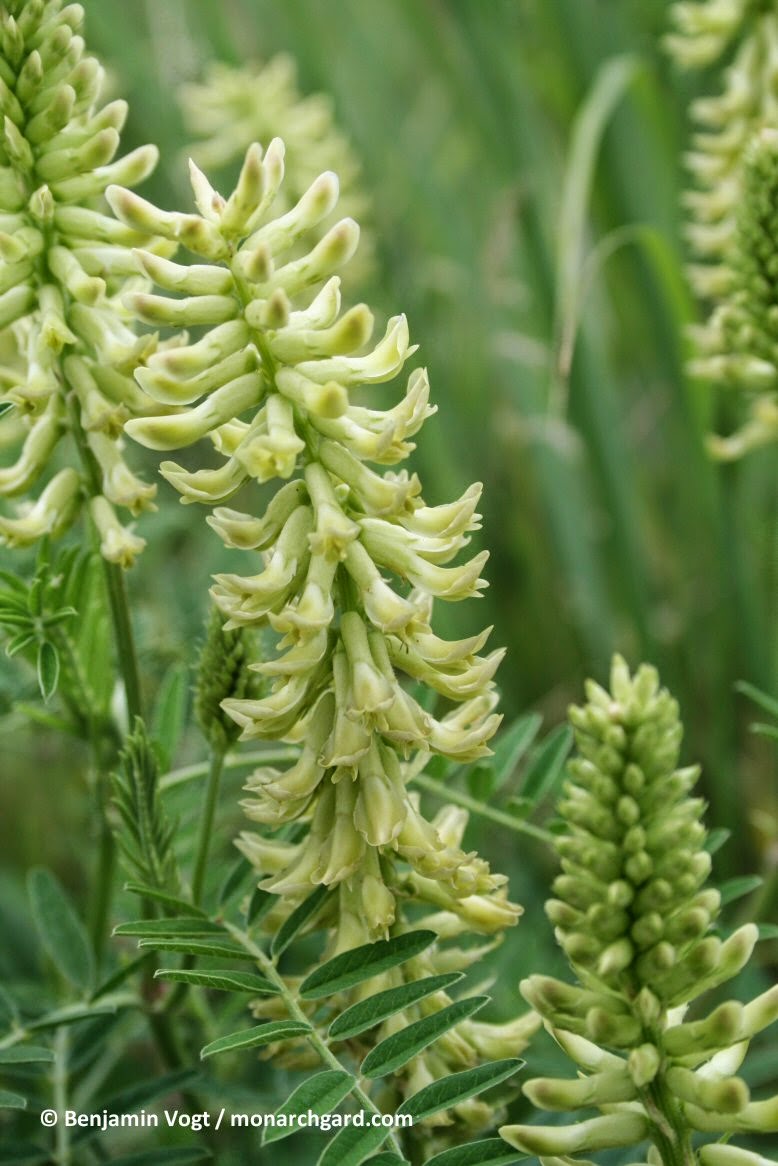
Canada milkvetch is blooming along the prairie paths; why I don't have this in my garden is a question for the ages.

A shot of leadplant, then grey headed coneflower behind it, then the cistern for the nature center further back. The nature center has a bit of green roof to it, as well, which you can see in the next image.

The west side of the building features slightly more formal beds were many events are held on the green space. Some good pollinator plants in here to learn about, but also in the entire 668 acres of prairie, woodland, and creek. I'd have images of elk and bison for you if I'd not committed a photographer's cardinal sin -- not bringing a backup camera battery.
Above is a shot on the east side of the nature center. In the foreground is a pollinator garden, with prairie behind it. Taking a walk north and west will get you into some nice tallgrass with stands of common milkweed perfuming the air in a spiced vanilla. Lots of birds and insects taking advantage of this semi urban oasis.
A closer look at some perennials and annuals in the bioswale.
Canada milkvetch is blooming along the prairie paths; why I don't have this in my garden is a question for the ages.
A shot of leadplant, then grey headed coneflower behind it, then the cistern for the nature center further back. The nature center has a bit of green roof to it, as well, which you can see in the next image.
The west side of the building features slightly more formal beds were many events are held on the green space. Some good pollinator plants in here to learn about, but also in the entire 668 acres of prairie, woodland, and creek. I'd have images of elk and bison for you if I'd not committed a photographer's cardinal sin -- not bringing a backup camera battery.
Wednesday, July 16, 2014
Is There Any Difference Between a Land Ethic and a Garden Ethic?
"The land ethic simply enlarges the boundaries of the community to include soils, waters, plants, and animals, or collectively: the land.... That land is a community is the basic concept of ecology, but that land is to be loved and respected is an extension of ethics.... A land ethic, then, reflects the existence of an ecological conscience, and this in turn reflects a conviction of individual responsibility for the health of land.... We can be ethical only in relation to something we can see, feel, understand, love, or otherwise have faith in.... A land ethic changes the role of Homo sapiens from conqueror of the land-community to plain member and citizen of it...it implies respect for his fellow-members, and also respect for the community as such."

And I found this definition of ethics interesting:
People tend to use the term "ethics" in two different ways.
1) Ethics help us decide how we ought to live. In their most general form, we might say that ethics are standards we employ (among other factors) to determine our actions. They are prescriptive in that they tell us what we should or ought to do and which values we should or ought not hold. They also help us evaluate whether something is good or bad, right or wrong.
Leopold's example: "A land ethic changes the role of Homo sapiens from conqueror of the land-community to plain member and citizen of it...it implies respect for his fellow-members, and also respect for the community as such."
2) Ethics explain why things are important to us. Ethics are also concerned with how and why we value certain things and what actions properly reflect those values. In this sense, ethics appear more descriptive. Just as it is possible for taste to be a neutral and descriptive term -- appreciation for a work of art can be a matter of taste -- ethics can operate the same way.
Leopold's example: "Sometimes in June when I see unearned dividends of dew hung every lupine, I have doubts about the real poverty of the sands... do economists know about lupines?"
-----
I think we need to do a much better job of applying Leopold's land ethic to the garden. Too often the garden is a place mostly for us -- our desires, our vision, our life; it's there to serve just us. This is not an ethical garden, and I don't think it truly reflects how we act or think of ourselves as part of a human or planetary community. At least I hope not. Thinking deeper, as part of a community of all life, frees us from the false ethics of self-privileging.
When we breed plants for traits we want, is this ethical? When we buy a plant that sees few insects using its blooms or leaves, but that we find beautiful, is this ethical? If we value ourselves above all else in the natural world, what will inevitably happen to us? These are hard, penetrating questions that disturb what we believe and shake the foundation of our perceived free will. This is how ethical thinking begins.
Sunday, July 13, 2014
An Ode to Prairie Clover
Ranchers refer to this protein-rich perennial as a candy plant because cattle love to eat it, so much so that in an overgrazed field you won't see any Dalea purpurea. And yet in a sandy or well drained loam it will spread vigorously, with roots reaching seven feet down. It thrives on disturbance. It's a survivor on the prairie.

Blooming from top to bottom, each spike won't last but a few days in high summer. Bees will come in droves of varying sizes and colors, some so small you can only hear them. A stand of purple prairie clover is subtle until the right light hits it -- usually morning or evening, sleep heavy across the landscape.

It's the perfect garden height at around two feet -- not so tall as to overwhelm, not so short as to underwhelm. In masses purple clover is like a transition from full season groundcovers to showier blooms that flaunt their dalliance with pollinators and garden visitors. It is a shadow which gives definition to other perennials.

"To make a prairie it takes a clover and one bee" wrote Emily Dickinson. And with its penchant to add nitrogen to the soil, purple clover helps the plants around it -- creating a more hospitable environment. It gives and it takes in equal measure.

Dalea purpurea. DAY-lee-uh prr-PUR-ee-uh. It echoes across the prairie, an ocean in an ocean of grass anchoring the world into this place.
Blooming from top to bottom, each spike won't last but a few days in high summer. Bees will come in droves of varying sizes and colors, some so small you can only hear them. A stand of purple prairie clover is subtle until the right light hits it -- usually morning or evening, sleep heavy across the landscape.
It's the perfect garden height at around two feet -- not so tall as to overwhelm, not so short as to underwhelm. In masses purple clover is like a transition from full season groundcovers to showier blooms that flaunt their dalliance with pollinators and garden visitors. It is a shadow which gives definition to other perennials.
"To make a prairie it takes a clover and one bee" wrote Emily Dickinson. And with its penchant to add nitrogen to the soil, purple clover helps the plants around it -- creating a more hospitable environment. It gives and it takes in equal measure.
Dalea purpurea. DAY-lee-uh prr-PUR-ee-uh. It echoes across the prairie, an ocean in an ocean of grass anchoring the world into this place.
Thursday, July 10, 2014
State of the Garden -- July 2014
I'm feeling quite angst-riddled with these images. Maybe I'm feeling penned in by 1,500' of garden. I know I've not exhausted what I can learn, but in order to learn I feel like there are areas I'd like to start from scratch in (or maybe I just need an acreage). I've already done that by removing butterfly bushes and sowing wildflower and grass seed in their place. Still.

Above is the shot up from the deck. I try to take photos from the same place whenever I go outside as a way to gauge evolution -- death and birth.

Here we are at ground level. I like the tall clumps of Coreopsis tripteris (left and right of the sumac), but that's about it. What's my problem?
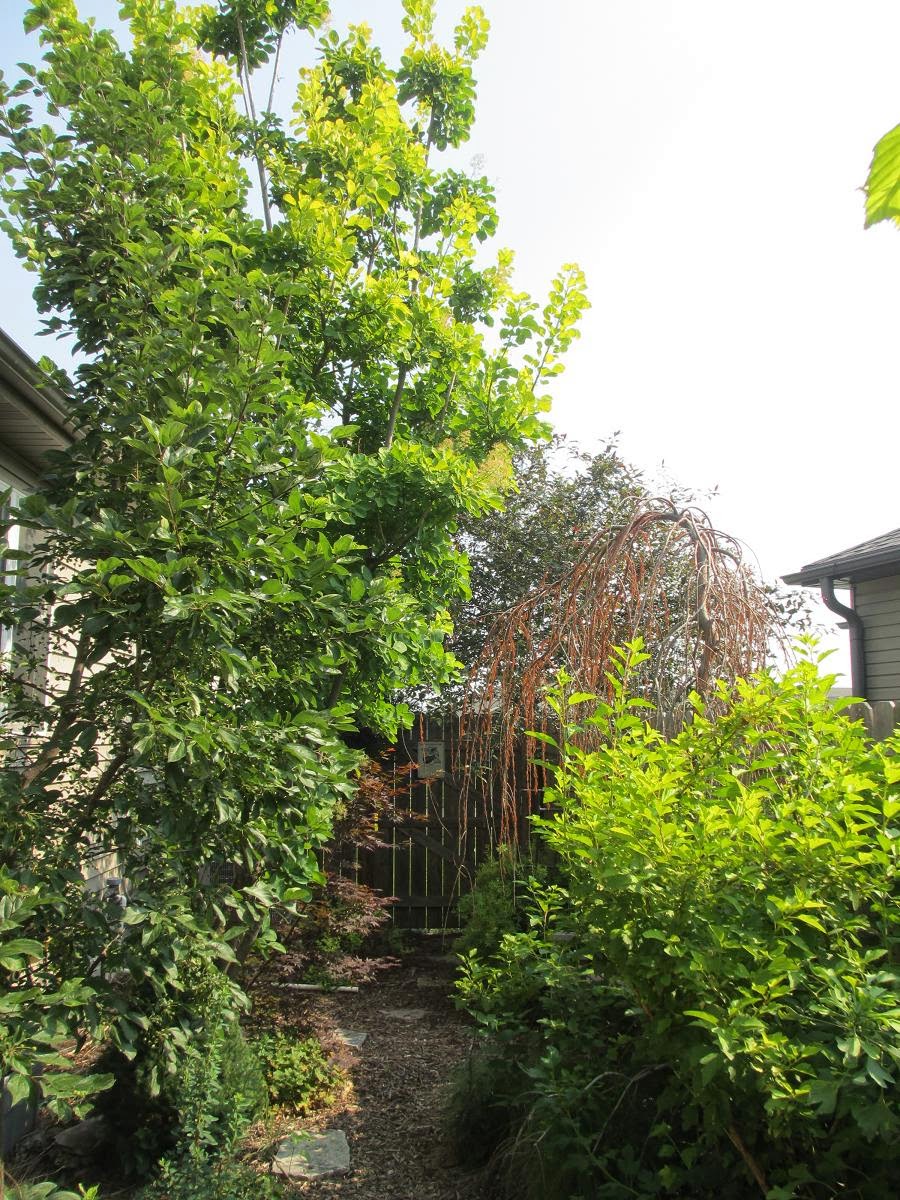
Here is looking toward the main gate. You'll notice 75% of the weeping bald cypress suddenly died after it leafed out. My prettiest small tree will be coming down, which is maybe just fine -- it's too big for that space and doesn't do much for wildlife. The smokebush is also a bit overbearing, though it's a bird nest mecca every year.

Turn around and you see the arbor and gigantic river birch. I need to limb it up to let in more light on the ground, but if I do that I'll have to watch my neighbor mow her lawn and play with her kid on the new trampoline.

Looking out a hole in the garden gate toward my narrow river 'o' prairie, which is looking ok in the sunnier area, not so much in the 50/50 spot closer to the fence. I reseeded prairie grasses a week ago and they are starting to come up finally -- lesson learned about bed prep and watering.

Back in the main garden a massed mess of forbs. Some monarda cultivar is taking over on the right, and the grey headed coneflowers have had a resurgence after a down year or two; whoever said you couldn't use grey headed coneflower plant in a small garden didn't plant thickly enough.

At least the Asclepias sullivantii is blooming. Just the one plant though. Smack dab in the middle of the path. I never can get it to set seed.

Looking back toward the deck and birch. This is why I get chiggers every year, chiggers being the main reason I'm not enjoying the garden much. I've had about seven million bites the last two years and refuse to go outside as often until August when they are non-biting adults, and when it's too muggy to go out anyway.

My garden slopes a bit, and here is the top of the hill behind some moisture-sucking red cedars that shade this area about half the growing season. So I have to contend with a wet soil in spring, dry in summer, sun and shade. I've had a hard time finding the right plants, so am sullying any good plantsman rep I had -- if I had one.

The Baptisia australis is looking good, but the annual infestation of genista moth larvae has begun and it will be 100% defoliated in about a week. The birds never eat the larvae. Why not? Once the baptisia vanishes for the year the white woodland asters behind will get blasted with sun, but it will help the Salvia azurea.

Sunflowers are starting up. I've let them go nuts in my veg beds against the house -- I love to look out of my office and living room windows to see bees at work, and in a month or two, birds flower hopping for seeds. It's not a pretty sight aesthetically right now, or at any point really, but I'm making a sacrifice in this area. Next year I'll use both beds for prairie forb crops.
Above is the shot up from the deck. I try to take photos from the same place whenever I go outside as a way to gauge evolution -- death and birth.
Here we are at ground level. I like the tall clumps of Coreopsis tripteris (left and right of the sumac), but that's about it. What's my problem?
Here is looking toward the main gate. You'll notice 75% of the weeping bald cypress suddenly died after it leafed out. My prettiest small tree will be coming down, which is maybe just fine -- it's too big for that space and doesn't do much for wildlife. The smokebush is also a bit overbearing, though it's a bird nest mecca every year.
Turn around and you see the arbor and gigantic river birch. I need to limb it up to let in more light on the ground, but if I do that I'll have to watch my neighbor mow her lawn and play with her kid on the new trampoline.
Looking out a hole in the garden gate toward my narrow river 'o' prairie, which is looking ok in the sunnier area, not so much in the 50/50 spot closer to the fence. I reseeded prairie grasses a week ago and they are starting to come up finally -- lesson learned about bed prep and watering.
Back in the main garden a massed mess of forbs. Some monarda cultivar is taking over on the right, and the grey headed coneflowers have had a resurgence after a down year or two; whoever said you couldn't use grey headed coneflower plant in a small garden didn't plant thickly enough.
At least the Asclepias sullivantii is blooming. Just the one plant though. Smack dab in the middle of the path. I never can get it to set seed.
Looking back toward the deck and birch. This is why I get chiggers every year, chiggers being the main reason I'm not enjoying the garden much. I've had about seven million bites the last two years and refuse to go outside as often until August when they are non-biting adults, and when it's too muggy to go out anyway.
My garden slopes a bit, and here is the top of the hill behind some moisture-sucking red cedars that shade this area about half the growing season. So I have to contend with a wet soil in spring, dry in summer, sun and shade. I've had a hard time finding the right plants, so am sullying any good plantsman rep I had -- if I had one.
The Baptisia australis is looking good, but the annual infestation of genista moth larvae has begun and it will be 100% defoliated in about a week. The birds never eat the larvae. Why not? Once the baptisia vanishes for the year the white woodland asters behind will get blasted with sun, but it will help the Salvia azurea.
Sunflowers are starting up. I've let them go nuts in my veg beds against the house -- I love to look out of my office and living room windows to see bees at work, and in a month or two, birds flower hopping for seeds. It's not a pretty sight aesthetically right now, or at any point really, but I'm making a sacrifice in this area. Next year I'll use both beds for prairie forb crops.
Tuesday, July 8, 2014
A Sign of the Times Around Here
The Rudbeckia hirta looks splendid around my public image enhancer (or detractor -- I do live in a militant suburb). Behind it leading to the garden gate is a meandering bed of red Coreopsis tinctoria, Rudbeckia amplexicaulis, and Ratibidia columnifera -- with a few shortgrasses trying to get going.

Monday, June 30, 2014
The Deeper "Politics" of Native Plant Gardens
Finger waggers. Overbearing. Politicizing. Being dogmatic. These are the most often used phrases to describe native plant advocates of all stripes. But what advocate doesn't come off like this, especially to someone with a different point of view? When anyone has an opinion about anything – from oil pipelines to twerking to drone strikes to soccer matches to tee shirts -- they open themselves to heated debate; if anything, my massive foray into social media has shown just how diabolical the waters of opinion are.
Some
native plant advocates certainly come off as uber passionate, perhaps zealous, maybe at times too "loud" (ahem). I bet much of the same was said about our greatest social change
advocates. But there’s something much deeper here besides the knee jerk
reaction to tone, diction, and passion -- the latter which I'm convinced most people really don't want others to have despite the plethora of memes saying so.
What's at the heart here is realizing how we garden effects the world in both negative and positive
ways. That cumulatively what we do on our ¼ acre lots is a massive destructive
or constructive force that also influences or is reflected in how we travel, drive, and source our lifestyle. This places a larger amount of responsibility on people already
burdened with things like mortgage payments, making dinner, kids’ piano
lessons, sick parents, a bad job…. We sure don’t need to think any more about
our lives, and certainly not in a way that complicates them – like a recent piece
I read that showed going vegetarian will cut your carbon footprint in half. Oh
goodness, “carbon footprint?” That opens up a whole can of worms about what I
can or cannot do, should or should not do, and butts right up against political
language and the divisive nature of our stagnant government where pro / con language creates a sort of animosity of thought.
 |
| Coreopsis, Dalea, Liatris |
But
you know what? The environment is a political issue. And it is such because it
is a moral issue. Almost every political impulse is inspired by a moral or ethical one
(for good or bad) – that’s why we have more and more freedoms being passed for those in the LGBT community, why we value clean water, why
we don’t want kids sucking on lead paint toys, why you don’t drink and drive, etc.
I was watching Kumi Naidoo, Greenpeace executive director, being interviewed by Bill Moyers. He talked about how Greenpeace was started by anti Vietnam War Quakers, and thus at Greenpeace's core is the idea of bearing witness -- here's how he explains it:
"If there's an injustice in the world, those of us that have the ability to witness it and to record it, document it and tell the world what is happening have a moral responsibility to do that. Then, of course, it's left up to those that are receiving that knowledge to make the moral choice about whether they want to stand up against the injustice or observe it."
For
some people a finger wag works. For others a passionate cry. For others a
gentle, slow, oft repeated plea. And for yet others example upon example of
what we should strive for no matter how uncomfortable it might be. Each person receives and accepts (or denies)
information given to them based on personal preferences influenced by their
cultural and social background or what kind of day they’ve had. It’s impossible
to convey meaning to someone in one sentence using a dozen different
strategies.
So
I’ve digressed, but if appearances are what we’re so concerned about in how we
talk about gardens and landscapes (and climate change and extinction), we’ll never ever have a good, deeper
conversation about them or how we fit into nature as a species which re-imagines
nature through our fallible emotions and intentions -- like gardens.
 |
| Asclepais syriaca & tuberosa -- Spring Creek Prairie, Nebraska |
Why
are native plants important for me? They are a bearing witness to our role in nature. They make me aware of environmental issues
close to home, like prairie loss which influences ecosystem services, agricultural issues such as topsoil loss
and water depletion, how plant communities function above and below the soil line -- they even provide a lesson in cultural and social inequality. Most importantly they empower me. I’m not buying into a
horticultural system that flashes the latest new thing in front of my eye like
I’m at a New York fashion show – I’m not a self centered consumer looking for
the newest temporary thrill without thinking on how that object was made; the act of buying something will only assuage my
tumultuous emotions in a complex world for a brief amount of time. Plants are
not LED televisions, sports cars, or shoes. Neither are pets, by the way.
I
think about my actions (some say dwell). It takes a bit more work, for sure,
and it makes me vulnerable to some negative stuff that hurts and shrinks my
human ego. But the thinking also makes me vulnerable to some pretty incredible
insights and transformations that embolden me to speak up for what I most care
about – the world that sustains us and which we still know so little about,
including ourselves. Without native plant gardens we will never fully understand who
we are, where we’ve come from, or where we’re going -- and if any of these directions
points us to what we really want for ourselves and those who come after.
Friday, June 27, 2014
Monthly Newsletter
Even I have a hard time keeping straight my Houzz articles, NPWG posts, social media accounts (6 of my own, another one I manage for a nonprofit), memoir and essay writing, and garden pics into one cohesive je ne sais quoi.
So I'm starting a monthly newsletter that will highlight selections from all of the above areas under my business name. I'm hoping you'll sign up. There will be some musing and ranting, native plant profiles, environmental links, news of my speaking and writing engagements, and pics of the garden -- a good place to catch up on all I do. Are you in? Click on the image to sign up.

So I'm starting a monthly newsletter that will highlight selections from all of the above areas under my business name. I'm hoping you'll sign up. There will be some musing and ranting, native plant profiles, environmental links, news of my speaking and writing engagements, and pics of the garden -- a good place to catch up on all I do. Are you in? Click on the image to sign up.
Sunday, June 22, 2014
A Summer Meditation
Because
I am unsure of myself I sow milkweed seeds. Because I am lost in a
chorus of worry and hope and faith and loss I dig bare-knuckled in the
soil. Because the world will not stand up and scream loud enough as the
landscapes we grew up with vanish, I do the only things I know to bridge
the gap -- the garden, these words, the patient late evening watching
of a few last fireflies lighting the coming darkness.

Tuesday, June 17, 2014
John Weaver Tells It Straight Up
"The disappearance of a major natural unit of vegetation from the
face of the earth is an event worthy of causing pause and consideration
by any nation. Yet so gradually has the prairie been conquered by the
breaking plow, the tractor, and the
overcrowded herds of man…that scant attention has been given to the
significance of this endless grassland or the course of its destruction.
Civilized man is destroying a masterpiece of nature without recording
for posterity that which he has destroyed." -- John Weaver

Thursday, June 5, 2014
Textures, Seed Heads, Exotic Last Stands, & Shame
It's June and the garden is growing about 17 feet per day. I'd just as soon it get on and make it to autumn, its prettiest time of year. But life goes by too fast already and all we are left with are echoes and shadows of our five senses. I give you one sense:

This last photo failed to load horizontally, but this is my shame area -- and it's out front, right by the door, between the garage and the sidewalk. I've decided I hate the mulch and so have used about 30 plugs of penn sedge so that, in several years, there'll be green mulch. Also gave away many non natives to make the area less messy (eclectic) and more, well, modern and contemporary (which is why the 30+ Carex arrived). I look forward to the soft green carpet. Also added a stand of little bluestem and sideoats grama for some architectural interest nearby. We'll see. Never been happy here.
 |
| Fountain pump gave out. Too lazy to check on it. |
 |
| Morning sunlight makes iris glow, and the dianthus is nice, though of no benefit to insects. |
 |
| Lots of green texture variety if you look for it... |
 |
| .... like on joe pye weed. |
 |
| Prairie smokin' |
 |
| A rarely photographed angle. |
 |
| Pasque flower seed heads are the best. |
 |
| View over my wife's PhD graduation present from my folks. |
This last photo failed to load horizontally, but this is my shame area -- and it's out front, right by the door, between the garage and the sidewalk. I've decided I hate the mulch and so have used about 30 plugs of penn sedge so that, in several years, there'll be green mulch. Also gave away many non natives to make the area less messy (eclectic) and more, well, modern and contemporary (which is why the 30+ Carex arrived). I look forward to the soft green carpet. Also added a stand of little bluestem and sideoats grama for some architectural interest nearby. We'll see. Never been happy here.
Friday, May 30, 2014
Deep Thinking on the Ethical Garden
I've been working for a week on talks for the Loess Hills Prairie Seminar and the Millersville Native Plants in the Landscape Conference, and I ran out of room to include some chunks of writing by others that have really guided my thinking. If / when this all ever turns into a book, I'd like to include these ideas. So for your reading pleasure:
David Gessner on slowing down our lives, how this focuses our ethical treatment of the planet and ourselves, about being patient (and oh how a garden teaches patience!):
As the writer Wendell Berry pointed out long ago, the environmental crisis is a crisis of character. It isn’t simply that too many of us are gulping down the gasoline and other goodies that corporations are forever dishing out; it’s also the way that we’re doing it. When we race to a thing, consume it, and then race off to the next thing, there’s no sense of our ever having gotten to know that thing—whether it’s a place, a person, an animal, or a resource. A culture of speed can quickly become a culture of glibness. There’s a reason that environmentalists who fight for the land and against the coring-out of the earth so often frame the battle as one waged on behalf of our children and grandchildren. It’s because—cliché though it may sound—that is exactly who we are fighting for. Patience begins when we acknowledge the value in taking this long-term view of things, when we justify the continued fight by citing something beyond our own immediate needs, or someone beyond ourselves.
Sara Stein telling it like it is:
We have left our land too retarded to take care of itself, much less to be of any help to us. This is not someone else’s problem. We — you and I and everyone who has a yard of any size — owns a big chunk of this country. Suburban development has wrought habitat destruction on a grand scale. As these tracts expand, they increasingly squeeze the remaining natural ecosystems, fragment them, and sever corridors by which plants and animals might refill the voids we have created. To reverse this process — to reconnect as many plant and animal species as we can to rebuild intelligent suburban ecosystems — requires a new kind of garden, new techniques of gardening, and, I emphasize, a new kind of gardener.
One of the most thoughtful reviews I have ever read, on a book I am anxious to read -- William Jordan's The Sunflower Forest. This chunk discusses how to embrace the pain of ecological destruction, turn it on its head to create power and define restoration work / gifting in the land and in our hearts:
David Gessner on slowing down our lives, how this focuses our ethical treatment of the planet and ourselves, about being patient (and oh how a garden teaches patience!):
As the writer Wendell Berry pointed out long ago, the environmental crisis is a crisis of character. It isn’t simply that too many of us are gulping down the gasoline and other goodies that corporations are forever dishing out; it’s also the way that we’re doing it. When we race to a thing, consume it, and then race off to the next thing, there’s no sense of our ever having gotten to know that thing—whether it’s a place, a person, an animal, or a resource. A culture of speed can quickly become a culture of glibness. There’s a reason that environmentalists who fight for the land and against the coring-out of the earth so often frame the battle as one waged on behalf of our children and grandchildren. It’s because—cliché though it may sound—that is exactly who we are fighting for. Patience begins when we acknowledge the value in taking this long-term view of things, when we justify the continued fight by citing something beyond our own immediate needs, or someone beyond ourselves.
To
state it another way, it’s about breaking free from the tyranny of now. One of
the great challenges in trying to get people—including politicians—to recognize
the reality of climate change is that there always seem to be a thousand other
problems that demand our immediate attention at any given moment. We’ll react
to emergency: a hurricane, a twister, a fire. But even then, will our reaction
really entail slowing down enough to reflect on what we ought to be doing, and
how we ought to be acting, in the long term—when we’re not directly
experiencing a crisis?
To
be truly patient is to choose one thing for a while. And that means not
choosing other things. It definitely means not choosing everything. In
my own life, I’ve learned that there are some goals that cannot be achieved
without putting other things aside. The writing of books, for instance. The
same could be said of almost any other large and worthy ambition—like, say,
saving the planet. As an essential tool for that long-term goal, patience is
more than just practical. It has the power to save us from ourselves.
Sara Stein telling it like it is:
We have left our land too retarded to take care of itself, much less to be of any help to us. This is not someone else’s problem. We — you and I and everyone who has a yard of any size — owns a big chunk of this country. Suburban development has wrought habitat destruction on a grand scale. As these tracts expand, they increasingly squeeze the remaining natural ecosystems, fragment them, and sever corridors by which plants and animals might refill the voids we have created. To reverse this process — to reconnect as many plant and animal species as we can to rebuild intelligent suburban ecosystems — requires a new kind of garden, new techniques of gardening, and, I emphasize, a new kind of gardener.
One of the most thoughtful reviews I have ever read, on a book I am anxious to read -- William Jordan's The Sunflower Forest. This chunk discusses how to embrace the pain of ecological destruction, turn it on its head to create power and define restoration work / gifting in the land and in our hearts:
Given
its universality, it should surprise us little that restoration is an encounter
with shame, in the face of our killing unwanted vegetation and exerting our
control over the land. This is especially shameful when we assure ourselves we
are engaging in restoration precisely in order to give life back to degraded
systems, and that our intention is to relinquish control over the land.
Restorationists cannot simply wave their divine hands, as a god might, and turn
back the ecological clock. Restorationists have to address the very real
limitations of their skills. But it is precisely by experiencing shame that
restoration produces value. As Jordan puts it: “The great value of ecological
restoration, I now believe, is that it provides an ideal, even unique context
for negotiating […] the development of a relationship between ourselves and the
classic landscape.”
In
this way, Jordan has radically transformed the terms of the environmental
debate. Other environmental ideologies posit either a fallen nature given to
exploitation by a redeemed and therefore innocent humanity, or posit a pristine
and inviolate nature immeasurably disturbed by an irretrievably wretched
humanity. Since there is a little monstrousness — a certain loss of sentimental
innocence — on both sides of the divide between humans and the rest of nature,
this acknowledgment can generate a newer solidarity with nature. There is,
Jordan says, a “continuity of shame” between humans and the rest of nature.
The
acknowledgment of shame, of our mortification at our human limitations, and of
the troubling brutality of nature, is not an end in itself. To merely stare
across the gulf between us and the rest of nature is to court horror, not
relationship. Relationship and its rewards come from dealing with shame. So,
what is the recipe for developing true community with nature through
restoration?
Ecological
restoration, meant in Jordan’s full sense, purportedly brings us into community
with the rest of nature in a number of distinctive ways. The practice makes us
aware of the repercussions of our ongoing involvement in sullying natural
systems. It provides a means of direct engagement with nature since, in
contrast to wilderness protection, for instance, it involves beneficent
trammeling (the restorationist is armed with a bow-saw rather than binoculars).
It is also redemptive insofar as it is “the first phase in the cycle of giving
and taking back that is the ecological foundation for any relationship.” To be
sure, the gift is inadequate and “unworthy.” If restoration culture enables us
to figuratively but productively deal with shame and with transcending shame,
then, arguably, we get to so-called higher values, including, Jordan argues,
beauty.
The
fact is that, for all of its claims to radicality, environmentalism is of a
piece with the shame-denying aspects of the broader culture it critiques.
Restoration ecology, by contrast, provides a new paradigm for thinking about
humans and nature.
And finally Thomas Rainer naming power:
The
front lines of the battle for nature are not the Amazon rain
forest or the Alaskan wilderness; the front lines are our backyards,
medians, parking lots, and elementary schools. The ecological warriors of the
future won’t just be scientists, engineers, or even landscape architects.
The ecological warriors of the future will be gardeners, horticulturists,
land managers, Department of Transportation staff, elementary school teachers,
and community association board members. Anyone who can influence a small
patch of land has the ability to create more nature. And the future
nature will look more and more like a garden.
Subscribe to:
Posts (Atom)